


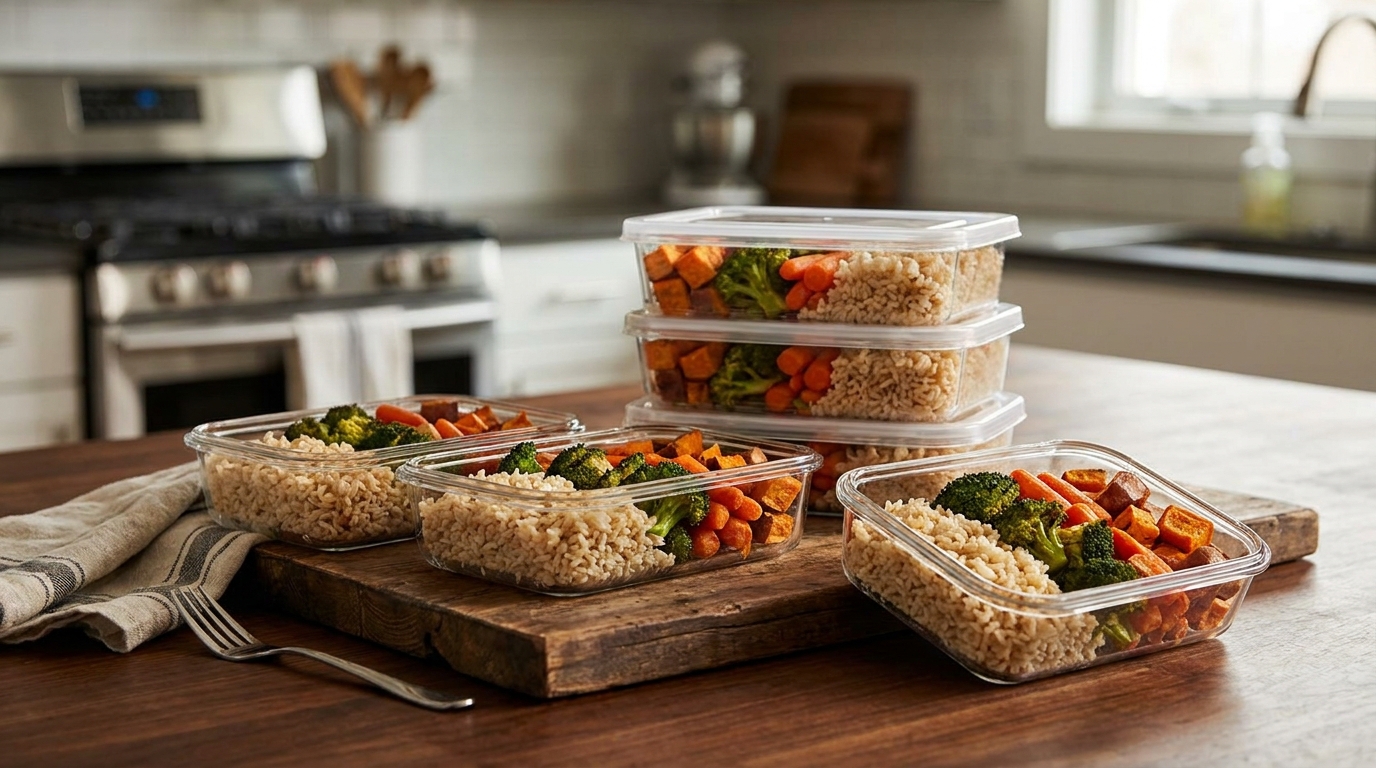
The short answer: Choose a few repeatable meals, write down the portions, and buy ingredients that work in more than one dish. Cook your main lunch components together, refrigerate only the portions you will eat within three to four days, and freeze later portions promptly. A seven-day plan does not mean keeping seven days of cooked food in the refrigerator.
The template below provides breakfast, lunch, and dinner for one adult for seven days. It is an organizational example, not a personalized calorie target or a guarantee that these portions meet your needs. Add food or adjust portions for appetite, activity, preferences, and any dietary requirements. Snacks and drinks are not included in the shopping quantities.
There is no universal $50 grocery basket: country, store, season, pack size, and pantry supplies change the total. Price this list locally before shopping. For the broader eating framework, see nutrition for calisthenics.
The three meals to repeat
All grain and lentil weights below are dry. Chickpea weights are drained; vegetable and potato weights are edible weights before cooking. Milk and yogurt may be replaced with suitable alternatives, but their nutrition will differ.
| Meal | Ingredients for one serving | Preparation |
|---|---|---|
| Oat breakfast | 40 g oats, 200 ml milk, 100 g plain yogurt, 1 banana | Cook the oats with milk according to the pack; add yogurt and sliced banana. Make fresh rather than storing seven assembled breakfasts. |
| Rice and lentil lunch bowl | 60 g rice, 60 g lentils, 200 g mixed vegetables, 5 ml oil | Cook rice and lentils separately according to their packs; combine with cooked vegetables and seasonings. Split into equal portions. |
| Egg and potato dinner | 2 eggs, 250 g potatoes, 200 g vegetables, 5 ml oil | Cook potatoes and vegetables; serve with fully cooked eggs. Use boiling, baking, or a suitable pan method. |
| Chickpea pasta dinner | 75 g pasta, 120 g chickpeas, 150 g canned tomatoes, 100 g vegetables, 5 ml oil | Cook pasta; heat chickpeas, tomatoes, vegetables, and oil together as the sauce. |
Salt, pepper, herbs, and spices are optional pantry additions; check what you already have. Follow product cooking instructions, particularly for dried lentils. Canned lentils can be used instead, but their drained weight is not a one-for-one substitute for dry weight: plan the replacement from the label and recalculate your shopping amount.
The seven-day menu
| Day | Breakfast | Lunch | Dinner |
|---|---|---|---|
| Monday | Oat breakfast | Rice and lentil bowl — refrigerated portion | Egg and potato dinner |
| Tuesday | Oat breakfast | Rice and lentil bowl — refrigerated portion | Chickpea pasta |
| Wednesday | Oat breakfast | Rice and lentil bowl — refrigerated portion | Egg and potato dinner |
| Thursday | Oat breakfast | Rice and lentil bowl — thawed frozen portion | Chickpea pasta |
| Friday | Oat breakfast | Rice and lentil bowl — thawed frozen portion | Egg and potato dinner |
| Saturday | Oat breakfast | Rice and lentil bowl — thawed frozen portion | Chickpea pasta |
| Sunday | Oat breakfast | Rice and lentil bowl — thawed frozen portion | Egg and potato dinner |
Change the seasonings, not the entire shopping list, when you want variety. A tomato-and-herb bowl and a cumin-seasoned bowl can share the same base ingredients. Use frozen vegetables if they suit your local prices and storage space; compare package prices rather than assuming one format is always cheaper.
Shopping quantities for the menu
These totals match seven breakfasts, seven lunch bowls, four egg dinners, and three pasta dinners. They are ingredient amounts used, not necessarily the pack sizes you must buy.
| Ingredient | Total needed |
|---|---|
| Oats | 280 g |
| Milk | 1.4 litres |
| Plain yogurt | 700 g |
| Bananas | 7 |
| Dry rice | 420 g |
| Dry lentils | 420 g |
| Mixed vegetables | 2.5 kg |
| Eggs | 8 |
| Potatoes | 1 kg |
| Dry pasta | 225 g |
| Canned chickpeas | 360 g drained weight |
| Canned tomatoes | 450 g |
| Oil | 70 ml |
The vegetable total is 1.4 kg for lunches, 800 g for egg dinners, and 300 g for pasta dinners. Buy chickpeas by drained weight on the label. If your packs are larger than the amounts listed, record the remainder and plan a use or safe storage method rather than treating it as waste.
A batch-prep workflow
- Check storage first. Have enough shallow containers and freezer space. Keep the refrigerator at 40°F/about 4°C or below and the freezer at 0°F/about −18°C or below; use appliance thermometers.[2]
- Prepare the lunch base. Cook 420 g dry rice and 420 g dry lentils according to their separate instructions. Cook 1.4 kg vegetables and include the lunch allocation of 35 ml oil. Divide each component evenly among seven lunch portions. Cooked yield varies, so do not assume that the dry weights are the finished serving weights.
- Cool and store promptly. Divide food into shallow containers rather than leaving a large pot on the counter. Refrigerate perishables within two hours, or one hour when temperatures exceed 90°F/32°C.[1] Do not wait for a whole pot to become room temperature before refrigerating.
- Separate early and late meals. Keep Monday–Wednesday lunches refrigerated. Freeze Thursday–Sunday portions promptly after portioning and cooling safely; label them with the preparation date and meal. Freezing does not rescue food already held unsafely.[1,2]
- Move one frozen portion to the refrigerator ahead of use. Thaw in the refrigerator, not on the counter. Reheat leftovers to 165°F/about 74°C, checked with a food thermometer; stir so the middle heats too.[1]
- Make breakfasts and dinners as needed. The menu batches lunches, not every meal. Use dairy within its storage instructions and dates. Refrigerate opened canned foods appropriately and follow their labels; freeze excess tomato or chickpea portions if they will not be used in time.
If you lack freezer space, scale down to two or three days of lunches and repeat the cooking process. That is a better plan than extending refrigeration to fit a calendar.
Make the plan easier or more suitable
Start with three lunch portions only if a full batch feels overwhelming. Buy three-sevenths of the lunch ingredients and use the same storage rules. Add the other meals later. This is a practical simplification, not a prescribed diet progression.
For different appetites, adjust individual components rather than forcing yourself to finish a fixed serving. Someone needing more food might add a larger grain portion or an extra snack; someone with specific nutrition needs should use an individualized plan. Do not assume that all substitutions have the same protein content. The protein guide explains the broader protein question without turning this menu into a supplement requirement.
If you calculate nutrition, match each ingredient to its actual label or an appropriate USDA entry, including raw versus cooked state. For a database value expressed per 100 g, multiply by the edible ingredient weight divided by 100; add all ingredients, including oil and sauces, and divide by the actual number of servings.[3] Weigh liquids appropriately or use the label's stated volume serving. These are estimates, not laboratory measurements of your plate.
FAQ
Can I keep all seven lunch bowls in the fridge?
No. USDA guidance generally allows refrigerated leftovers for three to four days.[1] Freeze later portions promptly or cook smaller batches. A date label is useful, but it does not compensate for unsafe temperatures or slow cooling.
Is this a complete muscle-building diet?
It is a meal-planning example, not an assessed diet for your body size or training load. No calorie or protein target has been calculated for you. Use the nutrition guide for context and adjust food quantities to your circumstances.
What if I do not eat eggs or dairy?
Choose suitable alternatives and rebuild the shopping quantities from their labels. Do not count a plant drink, yogurt alternative, or egg substitute as nutritionally identical without checking. Consider allergens and product instructions.
How do I find the real weekly cost?
Record the local price and usable quantity of each pack. Separate the amount consumed from the cash needed to buy whole packs, then include any missing pantry ingredients. This article makes no fixed-price claim.
Can this work alongside a beginner training plan?
Yes, as an organizational starting point rather than a prescribed training diet. Pair meal planning with a manageable beginner calisthenics routine and adjust food intake rather than assuming a seven-day menu suits every training schedule.
References
- USDA FSIS — Leftovers and Food Safety. Storage, prompt cooling, thawing, and reheating guidance.
- FDA — Refrigerator Thermometers: Cold Facts about Food Safety. Refrigerator/freezer temperatures and safe handling limits.
- USDA FoodData Central — Foundation Foods Documentation. Ingredient weights and nutrient calculation framework; no meal-specific nutrition values are asserted here.