



The short answer: 16/8 fasting works for fat loss only because it cuts calories — trials show no metabolic advantage over standard dieting. In the JAMA TREAT trial, 16/8 dieters lost 0.94 kg in 12 weeks, and roughly 65% of that loss was lean mass. Pair it with 1.6 g/kg protein and resistance training or you will lose muscle.
What 16/8 Does and Does Not Do
Time-restricted eating means you eat inside an 8-hour window (say 12:00 to 20:00) and drink only water, black coffee, or plain tea for the other 16 hours. That is the whole protocol. Everything else you have read about it is either a downstream effect of eating less, or unproven in humans.
| Claim | Evidence status | What actually happens |
|---|---|---|
| Burns more fat than normal dieting | Not supported | Matched-calorie trials show the same fat loss |
| Makes you eat less without trying | Supported | Most people drop 200–550 kcal/day by default |
| Spikes growth hormone and “boosts metabolism” | Overstated | GH rises during the fast; body-composition outcomes do not follow |
| Protects muscle | Not supported | TREAT found greater lean-mass loss in the 16/8 group |
| Improves insulin sensitivity | Mixed | Improvements track weight loss, not the eating window itself |
| Triggers autophagy that rebuilds you | Unproven in humans at 16 hours | Most evidence is rodent or cell-culture, at far longer fasts |
The Mechanism Is Calorie Control, Not Magic
Compressing your feeding window removes two eating occasions — breakfast and late-night snacking — for most people. That is a structural calorie cut of roughly 200 to 550 kcal per day, achieved without weighing anything. If you rebuild those calories inside the window (three large meals plus dessert), the fat loss disappears. Nothing about the clock overrides energy balance.
This is why 16/8 is best understood as an adherence tool. If “no food after 8 pm and none before noon” is a rule you can follow without thinking, it beats a calorie target you abandon in week three. If it makes you binge at 12:01, it is a worse tool than simply eating four normal meals. Our calisthenics nutrition guide covers the flexible alternative in detail.
What the Three Trials That Matter Found
| Trial | Design | Result |
|---|---|---|
| Lowe et al., JAMA Internal Medicine 2020 (TREAT) | 116 adults, 12 weeks, 16/8 vs 3 structured meals | −0.94 kg vs −0.68 kg — not statistically different. Significant lean-mass loss in the 16/8 group. |
| Moro et al., J Transl Med 2016 | 34 resistance-trained men, 8 weeks, 16/8 vs normal meals, both training | Fat mass fell more in 16/8; maximal strength and lean mass were maintained in both. |
| Trepanowski et al., JAMA Internal Medicine 2017 | 100 adults, 12 months, alternate-day fasting vs daily calorie restriction | No difference in weight loss at 12 months; fasting had the higher dropout rate. |
Read those three together and the picture is consistent. Fasting is not superior on paper. But the Moro trial — the only one where every participant lifted — is the one that matters for you, and its lesson is specific: the training and the protein are what protected the muscle, not the window. The TREAT participants were not required to train, and they paid for it in lean tissue.
The Muscle Problem, and How to Solve It
An 8-hour window gives you two, maybe three protein feedings. To hit 1.6–2.2 g/kg of bodyweight for a 75 kg person — 120 to 165 g of protein — you need 40 to 55 g per meal across three meals. That is a large amount of food in a short time, and it is the single most common reason 16/8 fails for people who train. Plan it before you start, using the numbers in our protein guide for bodyweight athletes.
| Bodyweight | Daily protein (1.6 g/kg) | Per meal, 3 meals | Practical example |
|---|---|---|---|
| 60 kg | 96 g | 32 g | 150 g chicken breast |
| 75 kg | 120 g | 40 g | 200 g Greek yogurt + 3 eggs |
| 90 kg | 144 g | 48 g | 200 g salmon + 250 ml milk |
The second requirement is a genuine resistance stimulus 3 times per week. Losing weight without a training signal tells your body that the muscle is not needed. Bodyweight work is enough — it does not need to be a barbell.
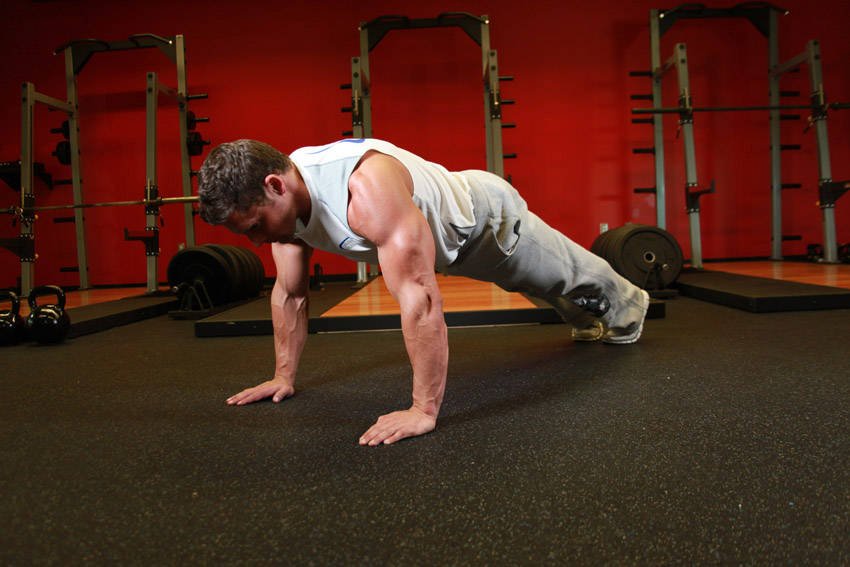
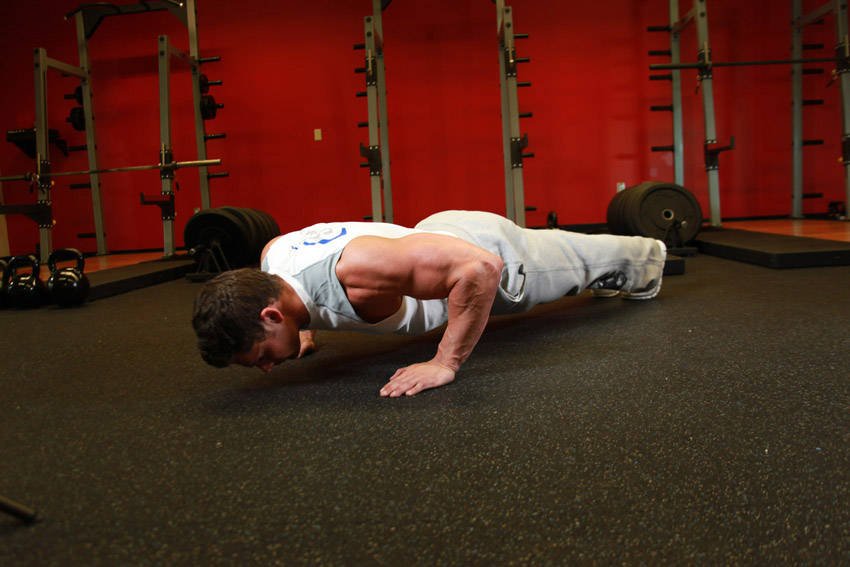
How to perform
- Lie on the floor face down and place your hands about 36 inches apart while holding your torso up at arms length.
- Next, lower yourself downward until your chest almost touches the floor as you inhale.
- Now breathe out and press your upper body back up to the starting position while squeezing your chest.
- After a brief pause at the top contracted position, you can begin to lower yourself downward again for as many repetitions as needed.


How to perform
- Stand with your feet shoulder width apart. You can place your hands behind your head. This will be your starting position.
- Begin the movement by flexing your knees and hips, sitting back with your hips.
- Continue down to full depth if you are able,and quickly reverse the motion until you return to the starting position. As you squat, keep your head and chest up and push your knees out.
Training Fasted: What Changes
Training at the end of a 16-hour fast is fine for sessions under 60 minutes at moderate intensity. Expect these specific changes, based on what consistently shows up in the fasted-training literature and in practice:
- Strength on your top sets: down roughly 5–10% for the first 2 weeks, then largely back to baseline as you adapt.
- Long conditioning work (over 45 minutes): noticeably harder. Move these sessions into the fed window.
- Skill work — handstands, levers, first pull-up attempts — is where fasted training hurts most. Do these fed. The pull-up progression assumes you are training with fuel available.
- Leg sessions at high volume are the worst candidates for fasted training; schedule bodyweight leg work inside the window.
A workable split: train at 11:00 fasted, break the fast at 12:00 with 40 g of protein, eat again at 15:30 and 19:30.
A 4-Week On-Ramp
Do not jump straight to a 16-hour fast. Compress the window gradually so appetite and training quality track together.
| Week | Eating window | Training | Pass test before advancing |
|---|---|---|---|
| 1 | 12 h (08:00–20:00) | 3 full-body sessions, fed | Protein target hit on 6 of 7 days |
| 2 | 10 h (10:00–20:00) | 3 sessions, fed | No evening binge; morning energy stable |
| 3 | 8 h (12:00–20:00) | 2 fed + 1 fasted session | Fasted session completed with under 10% rep loss |
| 4 | 8 h (12:00–20:00) | 3 sessions, any timing | Bodyweight trending down 0.3–0.7% per week |
How to perform
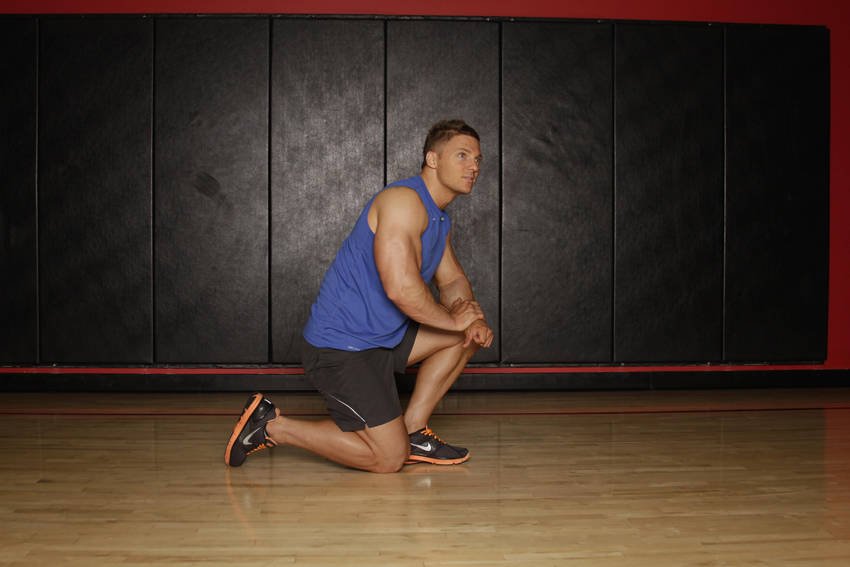
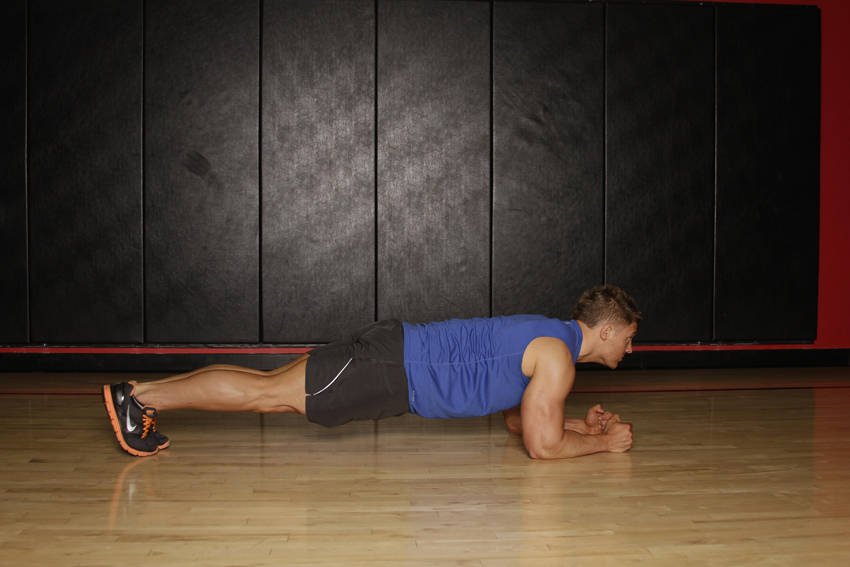
- Get into a prone position on the floor, supporting your weight on your toes and your forearms. Your arms are bent and directly below the shoulder.
- Keep your body straight at all times, and hold this position as long as possible. To increase difficulty, an arm or leg can be raised.
Who Should Skip 16/8
Time-restricted eating is a scheduling preference, not a health requirement. Skip it if you are pregnant or breastfeeding, have a history of disordered eating, take medication that requires food at fixed times, are managing diabetes on insulin or sulfonylureas without medical supervision, or are actively trying to gain weight. Adolescents should not use it. In all of those cases, three or four normal meals will serve you better and carry no downside.
FAQ
Does black coffee break a 16/8 fast?
No. Black coffee, plain tea, and water contribute essentially zero calories and do not affect the outcomes measured in any of the trials above. Milk, sugar, and “fasting-friendly” flavored powders do add calories — a 30 ml splash of whole milk is about 20 kcal, which matters only if you do it six times.
Will I lose muscle on 16/8?
Only if you skip resistance training or undershoot protein. The TREAT trial, where participants were not required to train, found significant lean-mass loss. The Moro trial, where all participants lifted and ate adequate protein, found lean mass preserved over 8 weeks. The variable is training and protein, not the window.
Can I train fasted every session?
You can, but you will pay for it on your hardest sessions. Keep skill work, long conditioning, and high-volume leg days inside the eating window. Fasted training suits sessions of 30–45 minutes at RPE 7 or below.
How long before I see results?
Expect 1–2 kg of scale weight in the first 2 weeks, most of it water and gut content. Real fat loss shows up at 0.3–0.7% of bodyweight per week from week 3 onward. If the scale has not moved after 4 consistent weeks, your window is not creating a calorie deficit — track intake for 5 days and find out where the calories are.
Is 16/8 better than 14/10 or 18/6?
There is no evidence that a specific window length is superior once calories match. Pick the longest fast you can hold without white-knuckling it. For most people who train, 14/10 with three protein feedings beats 18/6 with two.
References
- Lowe DA, et al. Effects of Time-Restricted Eating on Weight Loss and Other Metabolic Parameters in Women and Men With Overweight and Obesity: The TREAT Randomized Clinical Trial. JAMA Internal Medicine, 2020. doi:10.1001/jamainternmed.2020.4153
- Moro T, et al. Effects of eight weeks of time-restricted feeding (16/8) on basal metabolism, maximal strength, body composition, inflammation, and cardiovascular risk factors in resistance-trained males. Journal of Translational Medicine, 2016. doi:10.1186/s12967-016-1044-0
- Trepanowski JF, et al. Effect of Alternate-Day Fasting on Weight Loss, Weight Maintenance, and Cardioprotection Among Metabolically Healthy Obese Adults: A Randomized Clinical Trial. JAMA Internal Medicine, 2017. doi:10.1001/jamainternmed.2017.0936