


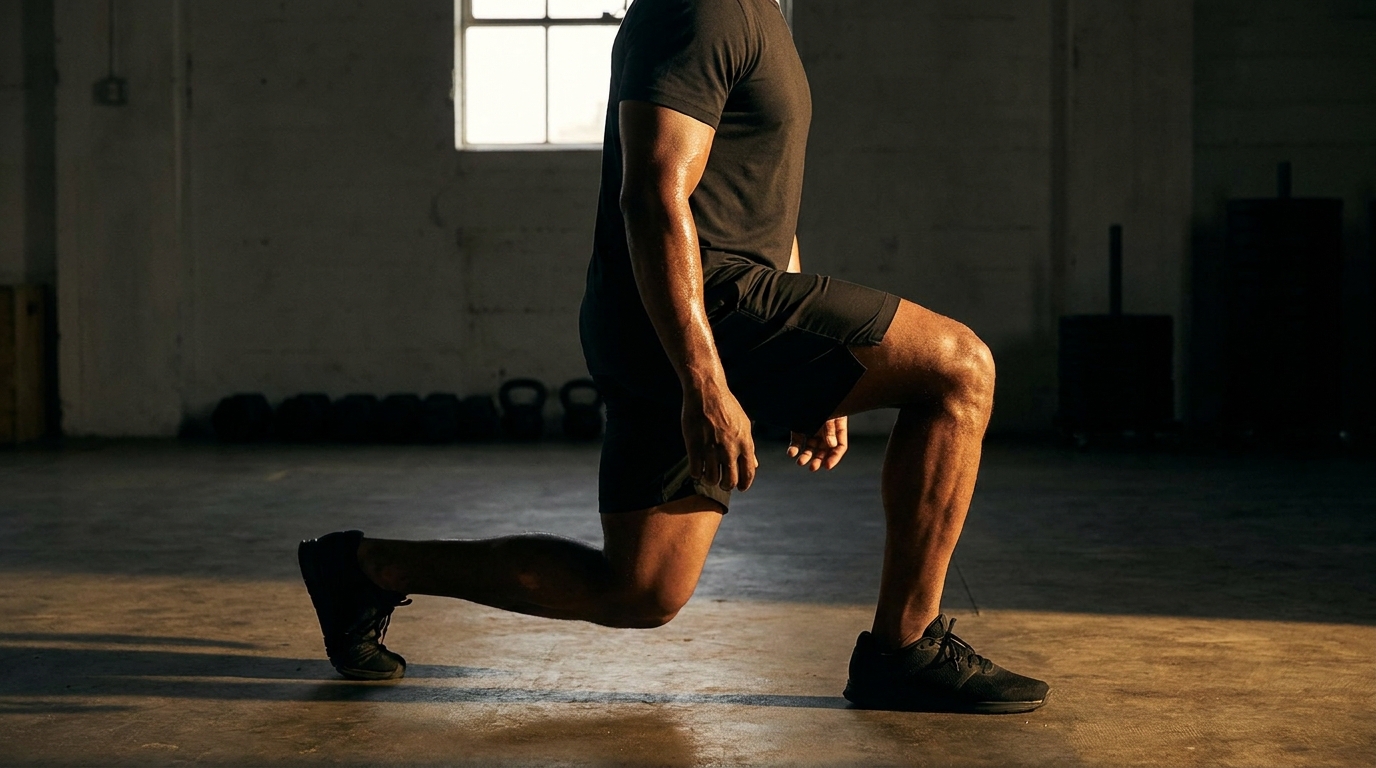
The short answer: Start with the squat variation you can repeat comfortably and control from beginning to end. That may be a supported mini-squat rather than a deep bodyweight squat. Build a small number of consistent repetitions before adding more sets, slowing the movement, or choosing a harder version. You do not need to jump or perform a pistol squat to begin.
The NHS describes supported mini-squats as a gentle strength exercise and recommends building up gradually.[1] The progression below is an editorial starting framework, not a validated test or a rehabilitation program. No variation is universally suitable. Stop if an exercise causes pain or makes you feel unwell; seek qualified advice if you have an injury, recurring symptoms, or uncertainty about suitability.
For the broader training picture, use the bodyweight leg training guide. This page focuses on choosing and progressing the squat itself.
Set up before choosing a level
Use a clear, nonslip floor and shoes or bare feet that give you reliable footing. If using a chair, choose a sturdy, non-wheeled chair that cannot slide or tip; position it securely against a wall when appropriate. Do not use a loose stool, unstable table, or someone else's moving hands as your support.
Start with your feet around hip-width apart. Allow a small adjustment in width and toe angle to find a comfortable position rather than forcing everyone into one exact stance. Bend at the hips and knees together, keep your feet in contact with the floor, and move only through a range you can control. Let your knees follow the general direction of your toes instead of collapsing inward.
You do not have to keep your torso perfectly vertical or reach a specific depth. Avoid treating an online photo as a mandatory position. Breathe throughout; do not hold your breath to force a difficult repetition.
A practical variation ladder
The order is a way to organize options, not a rule that every person must complete every step. Chair-target and free squats may feel different rather than uniformly easier or harder.
| Option | How to perform it | Make it easier | Consider changing it when… |
|---|---|---|---|
| Supported mini-squat | Hold a secure chair back or fixed support lightly. Bend your hips and knees a little, then stand smoothly. | Use a smaller bend and more hand support. | Five comfortable repetitions look similar and you do not have to pull yourself upright. |
| Chair-target squat | Stand in front of a secured chair, lower toward the seat, touch down gently or sit briefly, then stand. Keep the chair still. | Use a higher suitable seat or light hand assistance from a secure support. | You can avoid dropping onto the seat or rocking to stand. |
| Free bodyweight squat | Hold your arms forward if helpful, lower to a comfortable depth, and stand without bouncing. | Shorten the range or return to the chair target. | Your chosen number of repetitions remains controlled without losing balance. |
| Paused squat | Use your established free-squat range; pause briefly where you remain comfortable, then stand. | Remove the pause or reduce depth. | The pause does not make you hold your breath, collapse, or rush the next repetition. |
| Slow-lowering squat | Take roughly three seconds to lower, then stand smoothly. Use fewer repetitions if necessary. | Return to your normal controlled speed. | You can keep the same range and control across the set. |
A pause or slower lowering makes the same movement more demanding without requiring jumps. It is an option, not proof of superior results. If you cannot control the ordinary version, adding a long pause is not the next step.
Your first two weekly sessions
Leave a full day between squat-focused strength sessions.[3] For example, use Monday and Thursday rather than Monday and Tuesday. If another workout already challenges your legs, count that workload too.
| Part | Starting suggestion |
|---|---|
| Prepare | Walk or march gently for a few minutes, then try two or three easy practice repetitions. |
| Choose | Select a variation that allows five comfortable, controlled repetitions. This is a readiness check, not a maximum-effort test. |
| Work | Begin with one set of five. If that is clearly manageable, try a second set after you recover. |
| Rest | Wait until breathing and leg control are comfortable enough to repeat the movement. Around one to two minutes is a practical starting allowance; take longer if needed. |
| Record | Note the variation, range, support used, repetitions, and whether form stayed consistent. |
The NHS mini-squat example begins with five repetitions.[1] The exact session structure and rest allowance above are editorial suggestions. General CDC guidance describes strengthening at least twice weekly and explains that 8–12 repetitions can form a set, but you do not need to force yourself immediately into that range.[2]
Squats alone do not train all major muscle groups. Fit them into a wider plan, such as the beginner calisthenics guide, rather than turning every session into more squats.
Progress one thing at a time
After two comfortable sessions at the same setting, consider adding one repetition per set. This two-session check is a convenient logbook rule, not a scientifically established threshold. You can keep a variation longer.
Work gradually toward a repeatable set of roughly eight to ten if that remains comfortable. Then choose one adjustment: add another set, use a little less hand assistance, explore a slightly larger comfortable range, or try a paused version. Do not change all four at once.
When moving to a more demanding option, reduce repetitions again. Five good repetitions of a new version are more useful for checking control than chasing your previous count with a different movement. There is no timetable for reaching a deep or single-leg squat.
Troubleshooting without forcing the movement
- You fall onto the chair: use a higher appropriate target, more secure assistance, or a shallower mini-squat. Lower slowly; do not turn sitting down into a drop.
- Your heels lift or balance feels uncertain: reduce the range and return to a supported version. Do not force depth by shifting onto your toes.
- Your knees drift inward as you tire: end the set or use an easier version. Repeatedly correcting a failing repetition is not a reason to keep going.
- You feel pain: stop. Changing technique is not a substitute for assessing persistent or recurring symptoms.[3]
If you want a different leg movement, the lunge variations guide provides another set of options. A lunge is not automatically the right replacement for a painful squat; suitability still matters.
FAQ
How deep should I squat?
Only as far as you can move comfortably and control your return. The NHS supported mini-squat is deliberately shallow.[1] A deeper position is not a prerequisite for starting strength work, and forcing depth is not a progression strategy.
Should my knees stay behind my toes?
Do not use that as the only measure of a good repetition. Focus on a stable foot, controlled range, and knees moving generally with your toes. If a stance or range is uncomfortable, make it easier rather than obeying a rigid visual rule.
Do I have to progress to pistol squats?
No. Single-leg squats are a separate demanding skill. The pistol squat progression is an optional later topic, not the graduation test for this routine.
Can I squat every day?
This starting routine uses two separated strength sessions, not daily hard practice. Mayo Clinic advises a full day between training the same muscle group.[3] Include leg work from your other activities when judging recovery.
What counts as progress if I keep the same variation?
More consistent range, less reliance on assistance, or completing the same repetitions without rushing can all be useful logbook observations. They are not clinical measurements or guarantees of strength gain. Compare like with like rather than changing the movement every session.
References
- NHS — Strength exercises. Supported mini-squat setup and gradual starting repetitions.
- CDC — What Counts as Physical Activity for Adults. General strengthening frequency and major-muscle-group guidance.
- Mayo Clinic — Strength training: Get stronger, leaner, healthier. Rest between same-muscle sessions and stopping painful exercise.