


The short answer: bodyweight athletes build muscle on about 1.6 g of protein per kilogram of body weight per day — roughly 112 g for a 70 kg person. Split it across four meals of about 0.4 g/kg each. Past 2.2 g/kg there is no further gain in muscle or strength, no matter what the tub says.
Protein is the only macronutrient your body cannot improvise. You can train hard on low carbs and you can live on very little fat, but muscle is built from amino acids you ate, and there is no storage tank to draw on. The good news is that the numbers are small, boring and completely reachable without a single scoop of powder. This guide gives you the target, the per-meal dose, the distribution, and the food that gets you there.
Your Numbers, First
| Body weight | Daily target (1.6 g/kg) | Per meal (4 meals) | While cutting (2.2 g/kg) |
|---|---|---|---|
| 55 kg / 121 lb | 88 g | 22 g | 121 g |
| 65 kg / 143 lb | 104 g | 26 g | 143 g |
| 70 kg / 154 lb | 112 g | 28 g | 154 g |
| 80 kg / 176 lb | 128 g | 32 g | 176 g |
| 90 kg / 198 lb | 144 g | 36 g | 198 g |
| 100 kg / 220 lb | 160 g | 40 g | 220 g |
If you carry a lot of fat, calculate from your target weight rather than your current weight — protein needs scale with lean mass, not with total mass. A 110 kg person aiming for 85 kg uses the 85 kg row.
How Much You Actually Need
The 1.6 g/kg figure is not a round number someone invented. A 2018 meta-analysis pooled 49 resistance-training trials covering 1,863 participants and looked for the point where extra protein stopped adding muscle. The breakpoint landed at 1.62 g/kg/day. Above it, additional grams produced no further increase in lean mass — the curve flattens.
The same analysis put the upper edge of its confidence interval near 2.2 g/kg, which is where the common “about 2 g per kilo” advice comes from. That is the insurance number, not the requirement. Eating 2.2 instead of 1.6 costs you money and appetite; it does not cost you muscle, and it does not add any either.
Pass test: log everything you eat for three days without changing anything. If your average lands under 1.4 g/kg, protein is your highest-leverage fix. If it is already over 1.8 g/kg, protein is not what is limiting you — training volume or sleep is.
The 30-Gram Question
You have heard that the body can only use 20—30 g of protein per meal and the rest is wasted. That claim comes from a real study, and it has been badly misread ever since.
In the original 2009 trial, young men did resistance exercise and then ate 0, 5, 10, 20 or 40 g of egg protein. Muscle protein synthesis rose with dose and effectively maxed out at 20 g. The 40 g dose added only a small further response while sharply increasing amino acid oxidation. Hence “20 g is the ceiling.”
| Dose after training | Muscle protein synthesis | What it means for you |
|---|---|---|
| 0—10 g | Weak, submaximal | Too little; a snack, not a meal |
| 20 g | Near-maximal | The practical floor per meal |
| 40 g | Marginally higher, more oxidation | Not wasted, just not extra muscle |
| 0.4 g/kg per meal × 4 | Maximal across the day | The number to actually program |
Two things break the simple ceiling story. First, those subjects trained legs only; whole-body sessions recruit more tissue and raise the dose that saturates the response. Second, 20 g means something different for a 60 kg person than for a 95 kg one. A 2018 review resolved both by scaling the meal to body weight: about 0.4 g/kg per meal, over at least four meals, which conveniently lands on 1.6 g/kg for the day.
And “the rest is wasted” is simply wrong. Protein above the synthesis-saturating dose still gets absorbed, still spares lean tissue, and is unusually filling. It just does not buy additional muscle per gram. If a 50 g dinner is what fits your life, eat the 50 g dinner.
Distribution: Four Meals Beat Two
Total intake matters most, but how you spread it is the cheapest optimisation available. A 2013 study gave trained men the same 80 g of whey across 12 hours after leg training, in three patterns: eight 10 g doses every 90 minutes, four 20 g doses every 3 hours, or two 40 g doses every 6 hours. The four-dose pattern produced the highest myofibrillar protein synthesis. Frequent-and-tiny was too weak to trigger a response; rare-and-huge left long dead zones.
- Four anchors, 3—5 hours apart. Breakfast, lunch, post-training, dinner. That is the whole system.
- Every anchor clears 0.4 g/kg. A meal at 12 g is a snack that missed the trigger.
- Do not chase the 30-minute window. Anywhere within a couple of hours either side of training is equivalent for practical purposes. Consistency across the day beats stopwatch timing.
Pass test: for one week, name your four anchors in advance and count grams at each. If any anchor is regularly under target, that is the meal to fix — not the total.
Hitting the Number With Food
112 g of protein sounds like a lot until you see it as four meals of 28 g. Here is what 28 g looks like in ordinary groceries.
| Food | Serving | Protein | Notes |
|---|---|---|---|
| Chicken breast, cooked | 100 g | 31 g | Highest density per calorie |
| Canned tuna in water | 1 can, drained (100 g) | 25 g | Cheapest complete protein per gram |
| Greek yogurt, plain 0% | 170 g pot | 17 g | Slow-digesting; good before bed |
| Eggs | 2 large | 13 g | High leucine; pair with yogurt or oats |
| Cottage cheese | 100 g | 11 g | Mostly casein |
| Lentils, cooked | 200 g | 18 g | Plus ~15 g fibre |
| Firm tofu | 100 g | 15 g | Best-quality plant source |
| Milk | 250 ml | 8 g | Easy way to top up a light meal |
| Rolled oats, dry | 80 g | 11 g | Incomplete alone; combine |
Two worked examples for a 70 kg athlete needing 28 g per anchor: 200 g Greek yogurt with 40 g oats and a scoop of berries lands at 31 g. A tin of tuna, 200 g of lentils and a slice of bread lands at 46 g. Neither requires a supplement, a blender, or a delivery subscription.
Plant-Based Protein: Two Adjustments
Plant sources work, but they need two corrections rather than one. Most plant proteins carry less leucine — the amino acid that flips the synthesis switch — and several are low in one essential amino acid (grains in lysine, legumes in methionine).
- Raise the per-meal dose by about 25 percent. If your target is 28 g from animal sources, aim for 35 g from plants.
- Raise the daily target to roughly 1.8—2.0 g/kg. The extra covers lower digestibility.
- Lead with soy and pea. Tofu, tempeh, edamame and pea protein have the most complete amino acid profiles. Build the meal on those and let grains and nuts fill in.
- Combine within the day, not within the meal. The old “complementary proteins at every meal” rule was retired long ago; a varied day covers it.
Do You Need a Powder?
No. Powder is a convenience product, not a category of nutrition. It earns its place in exactly two situations: an anchor meal you routinely cannot cook, and a body weight high enough that 2 g/kg from whole food becomes an eating chore. If either applies, the choice between types is smaller than the marketing suggests — we break it down in our comparison of whey versus casein.
Rough guidance: whey digests fast and suits the post-training anchor; casein digests slowly and suits the last meal of the day; a soy or pea blend does both jobs adequately. Any of the three works if your daily total is right, and none of them works if it is not.
Protein While Cutting
A calorie deficit is the one situation where the higher end of the range genuinely pays. When energy is scarce your body will break down muscle for fuel, and a high protein intake is the main brake on that. Take 2.2—2.4 g/kg while dieting, keep training with the same intensity you used at maintenance, and accept a slower rate of loss — roughly 0.5 to 0.75 percent of body weight per week.
Protein also has the highest thermic effect and the strongest effect on satiety of any macronutrient, which makes the deficit easier to hold. This is the one time “eat more protein” is advice about adherence as much as physiology.
Protein Without a Stimulus Does Nothing
Every number above assumes you are giving your body a reason to build. Protein is the raw material; mechanical tension is the instruction. Eating 2 g/kg with no hard training does not build muscle — it builds an expensive urine stream. Three sessions per week hitting a vertical pull, a horizontal push and a squat pattern is enough to make the whole protein question worth asking.
How to perform
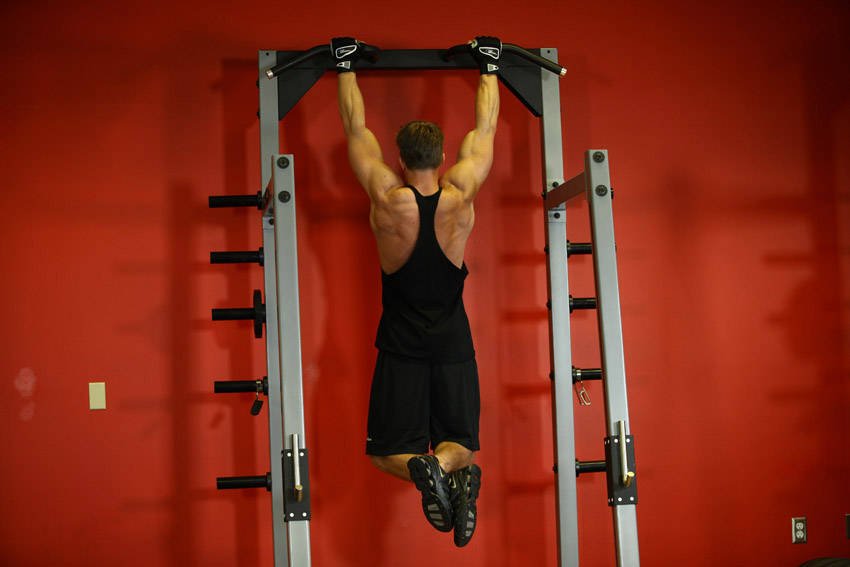
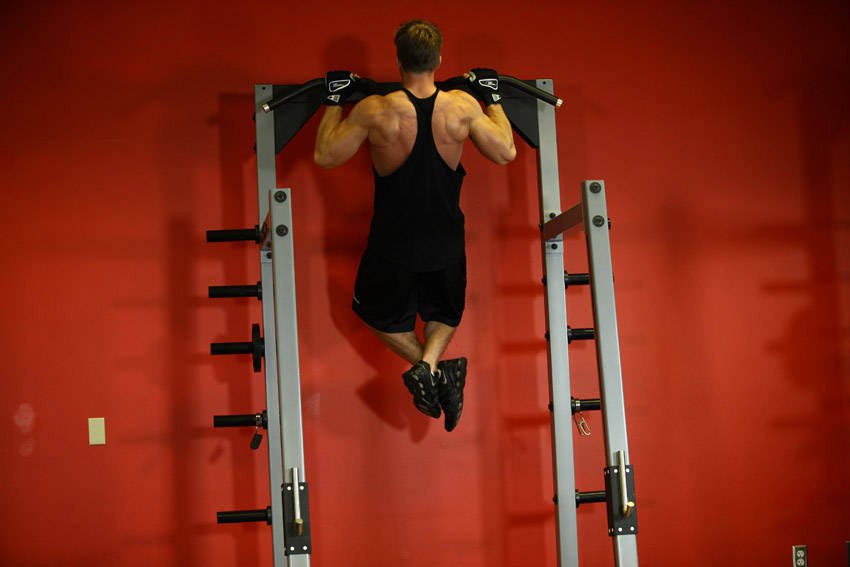
- Grab the pull-up bar with the palms facing forward using the prescribed grip. Note on grips: For a wide grip, your hands need to be spaced out at a distance wider than your shoulder width. For a medium grip, your hands need to be spaced out at a distance equal to your shoulder width and for a close grip at a distance smaller than your shoulder width.
- As you have both arms extended in front of you holding the bar at the chosen grip width, bring your torso back around 30 degrees or so while creating a curvature on your lower back and sticking your chest out. This is your starting position.
- Pull your torso up until the bar touches your upper chest by drawing the shoulders and the upper arms down and back. Exhale as you perform this portion of the movement. Tip: Concentrate on squeezing the back muscles once you reach the full contracted position. The upper torso should remain stationary as it moves through space and only the arms should move. The forearms should do no other work other than hold the bar.
- After a second on the contracted position, start to inhale and slowly lower your torso back to the starting position when your arms are fully extended and the lats are fully stretched.
- Repeat this motion for the prescribed amount of repetitions.
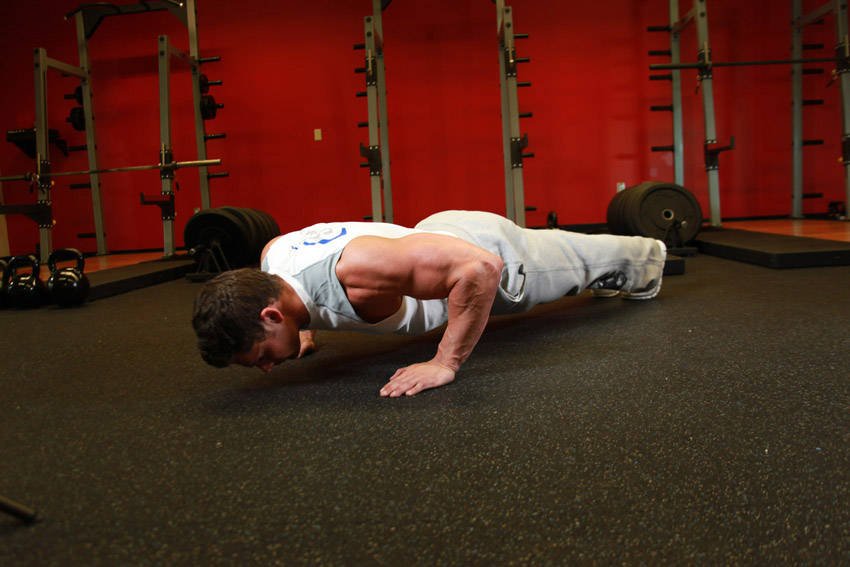
How to perform
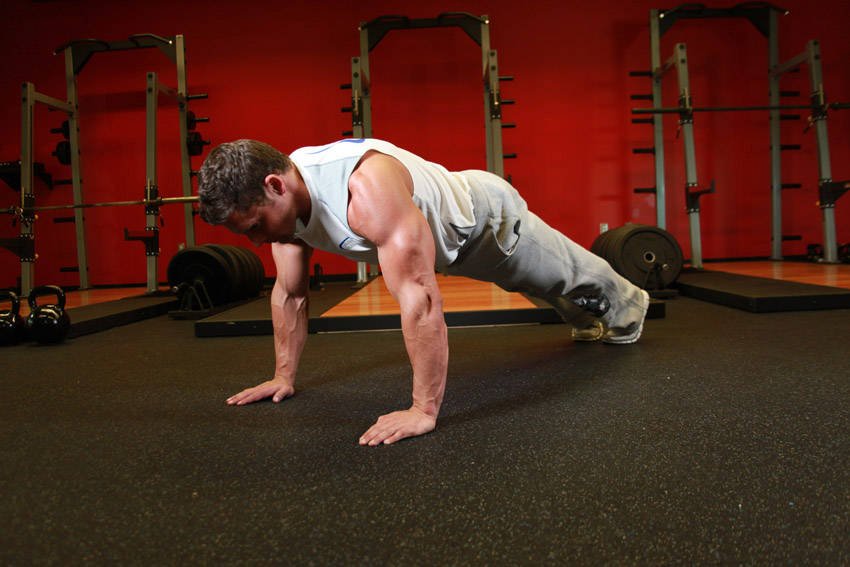
- Lie on the floor face down and place your hands about 36 inches apart while holding your torso up at arms length.
- Next, lower yourself downward until your chest almost touches the floor as you inhale.
- Now breathe out and press your upper body back up to the starting position while squeezing your chest.
- After a brief pause at the top contracted position, you can begin to lower yourself downward again for as many repetitions as needed.

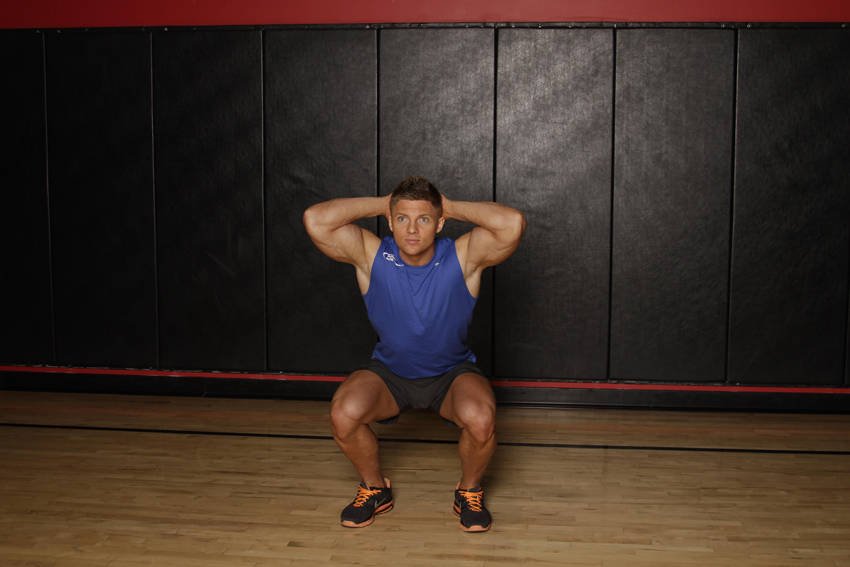
How to perform
- Stand with your feet shoulder width apart. You can place your hands behind your head. This will be your starting position.
- Begin the movement by flexing your knees and hips, sitting back with your hips.
- Continue down to full depth if you are able,and quickly reverse the motion until you return to the starting position. As you squat, keep your head and chest up and push your knees out.
If you are starting from zero, our pull-up progression is the fastest route to a real pulling stimulus, and the beginner calisthenics guide covers the full week. Once the movements are easy, progressive overload without weights is how you keep the stimulus climbing — and the wider bodyweight training guide ties the programming together.
Common Mistakes
- Back-loading the day. Coffee, a light lunch, then 90 g at dinner. The total looks fine on the app and the distribution is the worst of the three patterns tested.
- Counting protein from bread and rice. It counts toward the total but not toward a meal’s leucine trigger. Build meals around a dense source.
- Buying powder before fixing breakfast. Breakfast is where almost everyone loses 20 g, and eggs cost less than whey.
- Chasing 3 g/kg. Past 2.2 g/kg you are trading appetite and grocery budget for nothing measurable.
- Using BCAAs as a protein source. Three amino acids cannot build a muscle protein that needs twenty. Whole protein makes them redundant.
FAQ
How much protein do I need to build muscle?
About 1.6 g per kilogram of body weight per day, which is where a 49-study meta-analysis found gains stop increasing. That is 112 g for a 70 kg person. Going to 2.2 g/kg is harmless insurance; going beyond it adds nothing.
Is there really a 30-gram limit per meal?
No. Roughly 20 g maximally stimulates muscle protein synthesis in a single sitting for an average-sized person, but larger doses are still absorbed and used — they just do not add proportionally more synthesis. Scale to about 0.4 g/kg per meal instead of using a fixed number.
Do I need protein within 30 minutes of training?
No. The anabolic window is hours wide, not minutes. Hitting your daily total across four well-sized meals matters far more than the clock. If you trained fasted, eat reasonably soon; otherwise your next normal meal is fine.
Can I build muscle on a plant-based diet?
Yes, with two adjustments: raise the daily target to roughly 1.8—2.0 g/kg and build meals around soy, pea and legume sources rather than grains and nuts. Total intake and leucine content are what need covering, not the source itself.
Is high protein bad for your kidneys?
In people with healthy kidneys, intakes in the 1.6—2.2 g/kg range used in these studies have not been shown to cause damage. If you have diagnosed kidney disease, protein intake is a medical decision — ask your doctor rather than a training article.
References
- Morton RW, et al. (2018). A systematic review, meta-analysis and meta-regression of the effect of protein supplementation on resistance training-induced gains in muscle mass and strength in healthy adults. British Journal of Sports Medicine. PubMed 28698222
- Moore DR, et al. (2009). Ingested protein dose response of muscle and albumin protein synthesis after resistance exercise in young men. American Journal of Clinical Nutrition. PubMed 19106242
- Schoenfeld BJ, Aragon AA. (2018). How much protein can the body use in a single meal for muscle-building? Implications for daily protein distribution. Journal of the International Society of Sports Nutrition. PubMed 29497353
- Areta JL, et al. (2013). Timing and distribution of protein ingestion during prolonged recovery from resistance exercise alters myofibrillar protein synthesis. Journal of Physiology. PubMed 23459753