



The short answer: eat at maintenance calories plus or minus 10 percent depending on your goal, take 1.6 g of protein per kilogram of body weight daily across four meals, put 3—5 g/kg of carbohydrate around your training days, keep fat above 0.8 g/kg, and drink 30—35 ml/kg of water. No supplement changes any of those numbers.
Bodyweight training has an unusual nutritional profile. You are not moving external load, so absolute strength matters less than strength relative to what you weigh. That makes body composition part of the training program rather than a cosmetic afterthought: every kilogram you carry is a kilogram you pull over the bar. At the same time, calisthenics sessions are dense and high in volume, so under-eating wrecks the quality of the work. This guide sets the whole system — calories, the three macronutrients, hydration, timing, and how to eat it without a single supplement.
The Whole System on One Screen
| Variable | Building muscle | Maintaining | Losing fat |
|---|---|---|---|
| Calories | Maintenance +10% | Maintenance | Maintenance −15% |
| Protein | 1.6 g/kg | 1.6 g/kg | 2.2 g/kg |
| Carbohydrate | 4—5 g/kg | 3—4 g/kg | 2—3 g/kg |
| Fat | 1.0—1.2 g/kg | 0.9—1.1 g/kg | 0.8—1.0 g/kg |
| Water | 30—35 ml/kg | 30—35 ml/kg | 30—35 ml/kg |
| Expected weekly change | +0.2—0.35% body weight | ±0.2 kg noise | −0.5—0.75% body weight |
| Meals per day | 4 | 3—4 | 3—4 |
For a 70 kg athlete building muscle that reads: about 2,700 kcal, 112 g protein, 315 g carbohydrate, 75 g fat, 2.3 litres of water. Every section below explains where those numbers come from and what to do when yours do not behave.
Step 1: Find Your Actual Maintenance
Online calculators give you an estimate with an error bar of several hundred calories. Skip the estimate and measure. Eat the way you normally eat for two weeks, log it honestly, and weigh yourself every morning after the bathroom and before food. Average each week. If the two weekly averages are within 0.3 kg of each other, the calories you logged are your maintenance.
Then move one direction only. A 10 percent surplus is enough to build at the rate an adult can actually build — roughly 0.2 to 0.35 percent of body weight per week for someone past their first year of training. A 15 percent deficit strips fat at about 0.5 to 0.75 percent per week while leaving enough energy to train hard. Bigger moves in either direction buy you fat or muscle loss, not speed.
Pass test: you can state your maintenance calories from your own two-week data, not from a calculator. If you cannot, that is this week’s only nutrition task.
Step 2: Protein Is the Fixed Cost
Protein is the one macronutrient with a hard floor. A 2018 meta-analysis of 49 resistance-training trials found gains in lean mass stopped increasing at about 1.62 g/kg/day. In a deficit the number rises to 2.2—2.4 g/kg, because protein is the main brake on muscle loss when energy is scarce.
Split it into four anchor meals of roughly 0.4 g/kg each, 3—5 hours apart. A 2013 trial fed the same 80 g of protein over 12 hours in three patterns; four medium doses beat both eight small ones and two large ones for myofibrillar protein synthesis. That is the entire timing science worth acting on. Our complete protein guide works through the per-meal doses, the 30-gram myth, and what 28 g looks like in real groceries.
Pass test: name your four anchor meals out loud and give the protein grams for each. If any anchor is under 0.4 g/kg, fix that meal before touching anything else.
Step 3: Carbohydrate Is Your Training Quality
Calisthenics volume runs on glycogen. A session of pull-ups, dips, squats and core work sits squarely in the glycolytic zone — sets of 30 to 90 seconds, short rests, repeated. Cut carbohydrate hard and the first thing you lose is not fat, it is the last two reps of every set.
| Training week | Carbohydrate | For a 70 kg athlete | What it buys |
|---|---|---|---|
| 2 sessions, low volume | 2—3 g/kg | 140—210 g | Enough for the work; easiest in a deficit |
| 3—4 sessions, moderate | 3—4 g/kg | 210—280 g | Full sets, normal recovery between days |
| 5+ sessions or skill work | 4—6 g/kg | 280—420 g | Repeatable high-volume weeks |
| Rest day | Drop 50—80 g | −50—80 g | Calorie room without touching protein |
That last row is all the carb cycling anyone needs. Eat more carbohydrate on the days you train hard, less on the days you do not, keep protein flat, and let fat absorb the rest of the calorie difference. Elaborate high/medium/low rotations do not outperform this once total calories and protein match.
Pass test: your last set of the session should be within one or two reps of your first-set quality. If it collapses every session, add 50 g of carbohydrate to the meal before training for two weeks and retest.
Step 4: Fat Is a Floor, Not a Target
Dietary fat carries fat-soluble vitamins and supports hormone production, and dropping it very low for long stretches is where crash diets do their damage. Keep it at 0.8 g/kg minimum — 56 g for a 70 kg athlete — and let it float upward with whatever calories are left after protein and carbohydrate are set.
Practically, that means fat is the dial you turn, not a number you chase. Set protein first because it has a floor. Set carbohydrate second because it drives session quality. Fat fills the remainder. Olive oil, nuts, whole eggs, oily fish and full-fat dairy get you there without any planning at all.
Hydration: The Cheapest Performance Variable
Losing about 2 percent of body mass in fluid measurably degrades endurance and heat tolerance — 1.4 kg for a 70 kg athlete, which a hot hour of hard work reaches easily. Grip endurance and hold times go first, which matters more in calisthenics than in most training styles.
- Baseline: 30—35 ml per kilogram per day. 2.1—2.4 litres at 70 kg, before training.
- Around training: 400—600 ml in the two hours before, 150—250 ml every 15—20 minutes during a hard session.
- After: weigh yourself before and after a session once. Drink 1.25 litres for every kilogram lost.
- Sodium: only worth adding when a session runs past 60 minutes in heat or you are a visibly salty sweater. A pinch of table salt in your bottle does what a branded sachet does.
- Check: pale straw urine three or four times a day. Dark and infrequent means you are behind.
Meal Timing and Fasting Patterns
Timing is a rounding error next to totals, with two exceptions worth respecting. The first is protein distribution — four anchors beat two, as above. The second is having carbohydrate available before a demanding session; training genuinely fasted on a heavy pull day tends to cost you volume.
| Slot | Timing | What to eat | Example at 70 kg |
|---|---|---|---|
| Pre-training | 90—120 min before | 30—60 g carbohydrate + 25 g protein, low fat and fibre | Oats with yogurt and a banana |
| Pre-training (short notice) | 30 min before | 20—30 g fast carbohydrate only | A banana or a slice of bread with honey |
| Post-training | Within 2 hours | 28 g protein + 40—60 g carbohydrate | Tuna, rice and vegetables |
| Before bed | 60—90 min before | 25—30 g slow protein | 200 g Greek yogurt or cottage cheese |
If you prefer a compressed eating window, it works — provided the window is wide enough to fit three or four proper protein anchors. An eight-hour window at 12:00—20:00 gives you meals at 12:00, 15:30 and 19:30, which is workable. A four-hour window does not. We cover the evidence in detail in our guide to 16/8 intermittent fasting.
A Real Day at 70 kg
Numbers are easier to trust when you can see them as food. This is a maintenance day for a 70 kg athlete training in the early evening: about 2,450 kcal, 118 g protein, 280 g carbohydrate, 76 g fat.
| Meal | Food | Protein | Carbs |
|---|---|---|---|
| 08:00 | 80 g oats, 250 ml milk, 200 g Greek yogurt, banana | 36 g | 95 g |
| 12:30 | 120 g chicken, 200 g cooked rice, mixed vegetables, olive oil | 40 g | 60 g |
| 16:30 | 2 eggs, 2 slices wholegrain bread, apple | 19 g | 55 g |
| 19:45 (post-training) | 200 g cooked lentils, tin of tuna, potato, salad | 43 g | 70 g |
Total cost of that day in most countries is lower than a month of protein powder amortised across it. Nothing on the list needs a blender, a scoop or a subscription.
Eating Plant-Based
A fully plant-based diet supports calisthenics without difficulty, but it needs three adjustments rather than good intentions.
- Raise daily protein to 1.8—2.0 g/kg. Plant proteins digest slightly less completely and carry less leucine per gram.
- Anchor meals on soy, pea and legumes. Tofu, tempeh, edamame and lentils have the most complete amino acid profiles. Grains and nuts fill gaps; they do not lead meals.
- Watch four nutrients, not twenty: vitamin B12 (supplement it — there is no reliable plant source), iron (pair legumes with vitamin C, skip tea with meals), omega-3 (algae or ground flax), and calcium (fortified plant milk, tofu set with calcium).
None of This Works Without a Stimulus
Nutrition is permission, not instruction. Food lets your body build; mechanical tension tells it to. Three sessions a week covering a vertical pull, a horizontal push and a squat pattern is the minimum that makes any of the numbers above worth calculating.
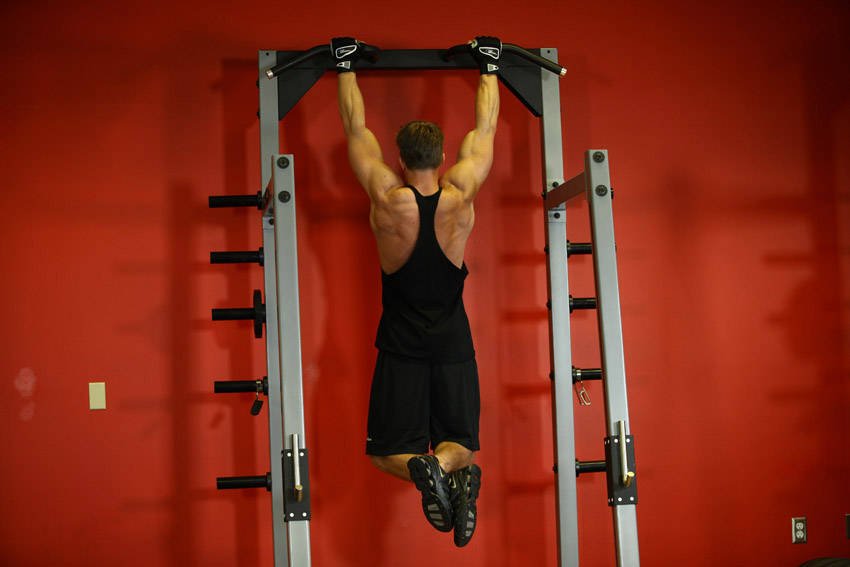
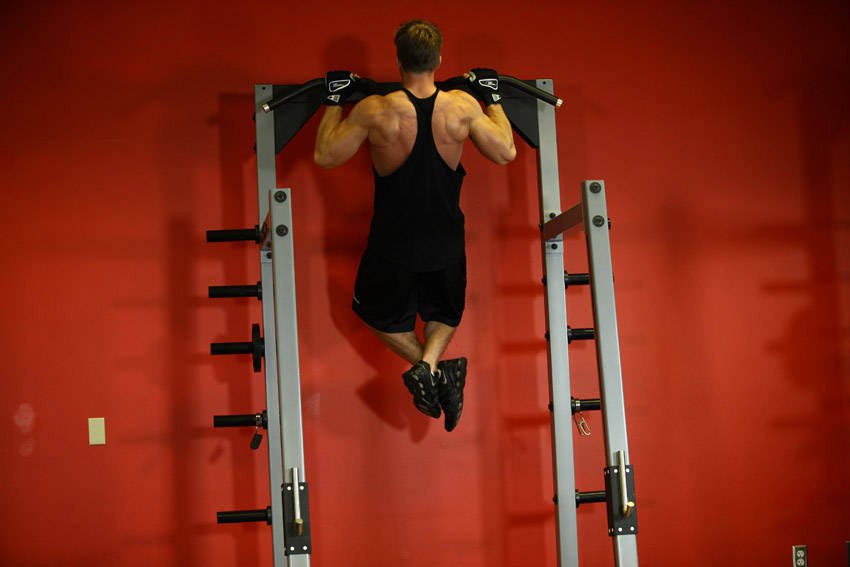
How to perform
- Grab the pull-up bar with the palms facing forward using the prescribed grip. Note on grips: For a wide grip, your hands need to be spaced out at a distance wider than your shoulder width. For a medium grip, your hands need to be spaced out at a distance equal to your shoulder width and for a close grip at a distance smaller than your shoulder width.
- As you have both arms extended in front of you holding the bar at the chosen grip width, bring your torso back around 30 degrees or so while creating a curvature on your lower back and sticking your chest out. This is your starting position.
- Pull your torso up until the bar touches your upper chest by drawing the shoulders and the upper arms down and back. Exhale as you perform this portion of the movement. Tip: Concentrate on squeezing the back muscles once you reach the full contracted position. The upper torso should remain stationary as it moves through space and only the arms should move. The forearms should do no other work other than hold the bar.
- After a second on the contracted position, start to inhale and slowly lower your torso back to the starting position when your arms are fully extended and the lats are fully stretched.
- Repeat this motion for the prescribed amount of repetitions.
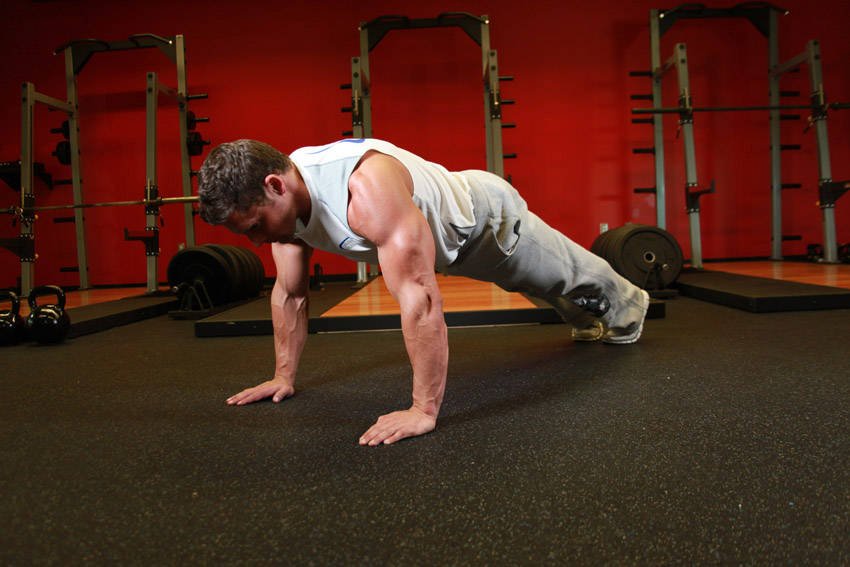
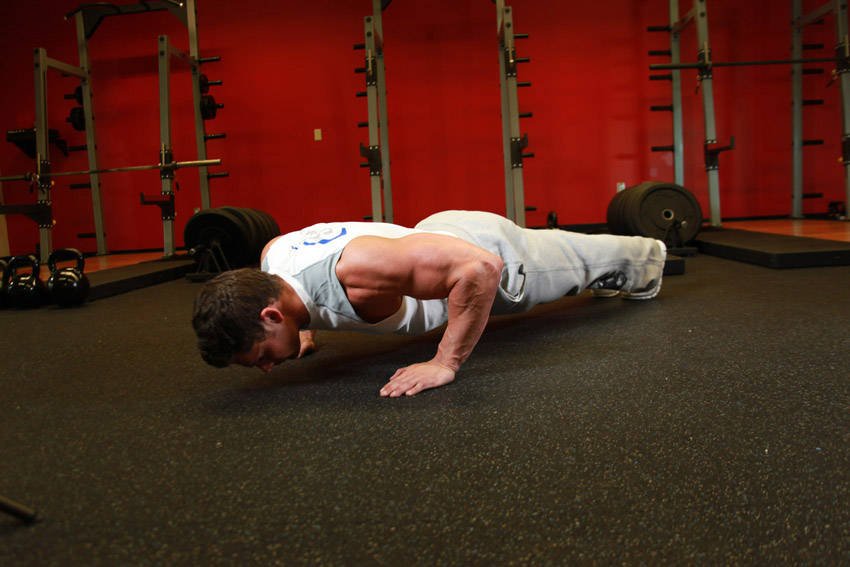
How to perform
- Lie on the floor face down and place your hands about 36 inches apart while holding your torso up at arms length.
- Next, lower yourself downward until your chest almost touches the floor as you inhale.
- Now breathe out and press your upper body back up to the starting position while squeezing your chest.
- After a brief pause at the top contracted position, you can begin to lower yourself downward again for as many repetitions as needed.

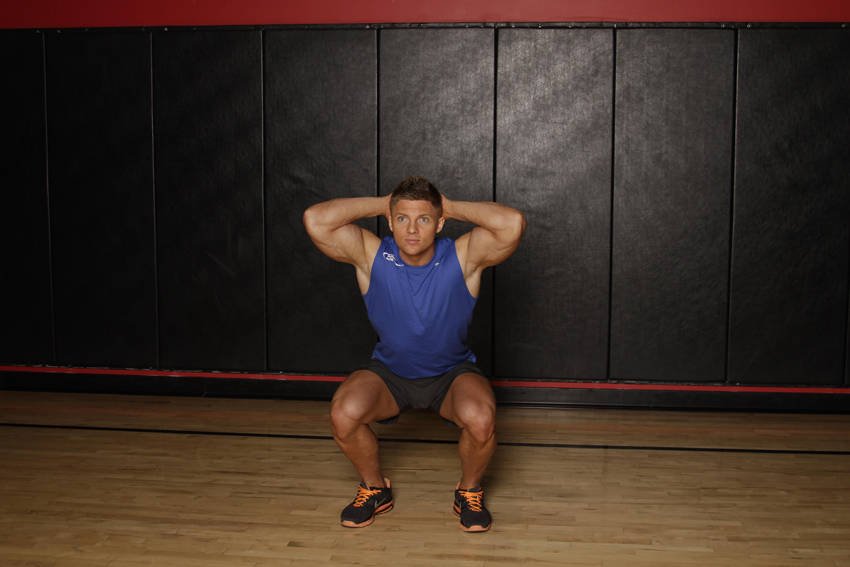
How to perform
- Stand with your feet shoulder width apart. You can place your hands behind your head. This will be your starting position.
- Begin the movement by flexing your knees and hips, sitting back with your hips.
- Continue down to full depth if you are able,and quickly reverse the motion until you return to the starting position. As you squat, keep your head and chest up and push your knees out.
If the pulling movement is the gap, our pull-up progression is the fastest route to a real stimulus. Once the basics feel easy, progressive overload without weights keeps the demand climbing, and the wider bodyweight training guide handles the weekly programming.
Common Mistakes
- Cutting and building at once. Pick one for at least 10—12 weeks. Alternating every fortnight produces neither.
- Cutting carbohydrate to lose fat. The deficit does the work. Cutting carbohydrate specifically just makes your training worse while you do it.
- Eating 70 percent of the day’s protein at dinner. The daily total looks correct in the app and the distribution is the least effective pattern tested.
- Buying supplements before fixing breakfast. Most people lose 20—25 g of protein and 500 ml of water before 10:00.
- Weighing yourself once a week. Daily weights averaged weekly; a single reading is mostly water and yesterday’s sodium.
- Chasing weight instead of ratio. In calisthenics, progress is reps per kilogram. Track both numbers or you will misread a good month as a bad one.
FAQ
How many calories do I need for calisthenics?
Measure rather than estimate: eat normally for two weeks, log it, and average your daily weight each week. Stable weight equals maintenance. Then add 10 percent to build or subtract 15 percent to lose fat. For most 70 kg trainees who move a normal amount, maintenance lands somewhere between 2,300 and 2,700 kcal.
Do I need supplements for bodyweight training?
No. Every number in this guide is reachable with ordinary groceries. Protein powder is a convenience for meals you cannot cook, and vitamin B12 is genuinely necessary on a fully plant-based diet. Nothing else on a supplement shelf changes calories, protein, carbohydrate or hydration.
Should I train fasted?
For an easy skill or mobility session, it makes no meaningful difference. For a hard, high-volume session it usually costs you a set or two of quality, which compounds over months. If your schedule forces morning training, 20—30 g of fast carbohydrate half an hour before recovers most of that gap.
How do I lose fat without losing pull-ups?
Keep the deficit at 15 percent or less, raise protein to 2.2 g/kg, and hold your training intensity constant while allowing a little less total volume. Losing 0.5 to 0.75 percent of body weight per week under those conditions usually improves pull-up numbers, because you are removing load without removing strength.
Does meal timing actually matter?
Two parts of it do. Spreading protein across four meals beats concentrating it in one or two, and having carbohydrate available before demanding sessions protects training quality. The 30-minute post-workout window does not — anywhere within a couple of hours is equivalent in practice.
References
- Morton RW, et al. (2018). A systematic review, meta-analysis and meta-regression of the effect of protein supplementation on resistance training-induced gains in muscle mass and strength in healthy adults. British Journal of Sports Medicine. PubMed 28698222
- Areta JL, et al. (2013). Timing and distribution of protein ingestion during prolonged recovery from resistance exercise alters myofibrillar protein synthesis. Journal of Physiology. PubMed 23459753
- Helms ER, Aragon AA, Fitschen PJ. (2014). Evidence-based recommendations for natural bodybuilding contest preparation: nutrition and supplementation. Journal of the International Society of Sports Nutrition. PubMed 24864135
- Sawka MN, et al. (2007). American College of Sports Medicine position stand: Exercise and fluid replacement. Medicine & Science in Sports & Exercise. PubMed 17277604