

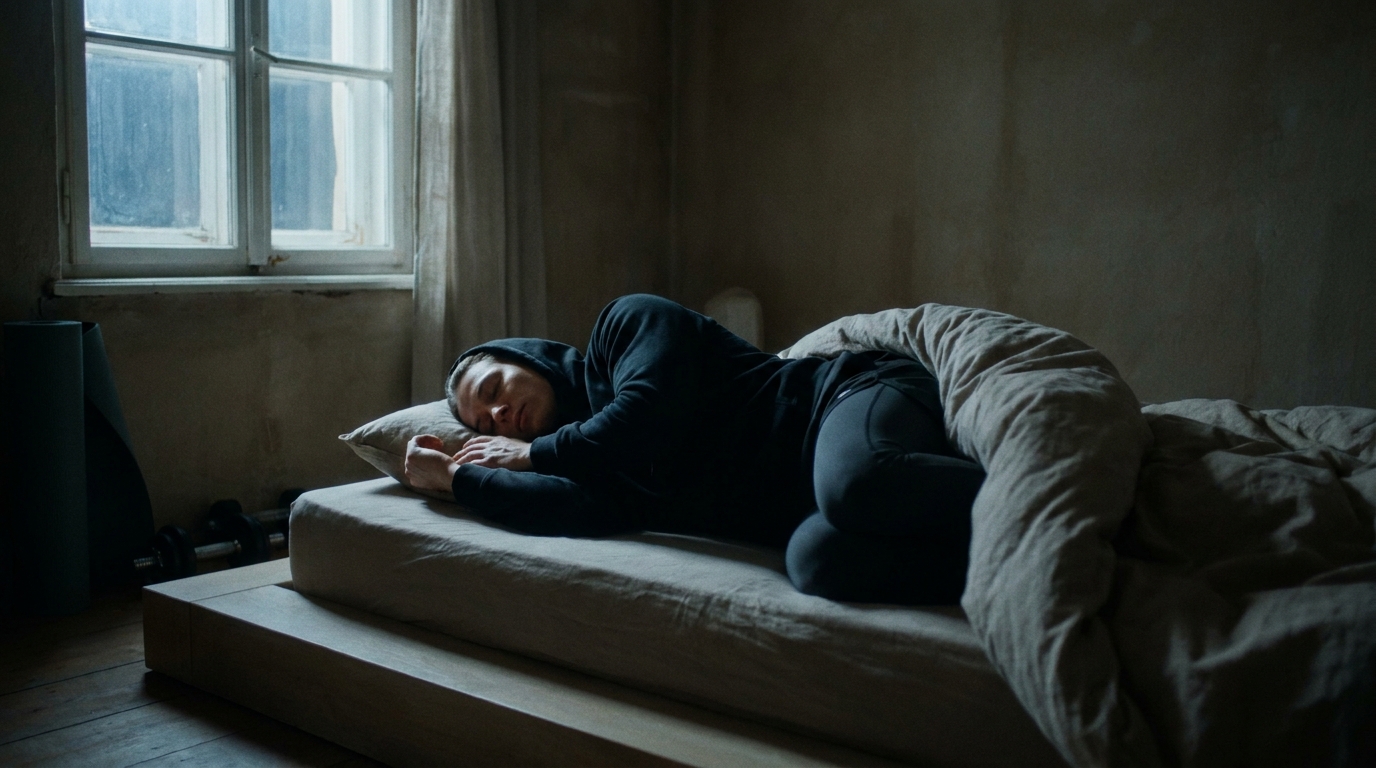
The short answer: Sleep is part of recovery, but no study can tell you exactly how much muscle you will gain or lose from a particular night's sleep. Most adults generally need seven to nine hours a night.[1] Research indicates that acute sleep loss can impair exercise performance, and small laboratory experiments suggest it can affect processes involved in muscle recovery.[3,4]
Those findings support taking sleep seriously. They do not justify a universal hormone percentage, a precise loss of strength after one short night, or a guarantee that sleeping longer will produce more muscle.
This guide explains the evidence and its limits. For a broader practical routine, use the separate sleep and recovery guide. The question here is narrower: what do studies actually measure, and how far can those findings be applied to your training?
Three different outcomes that often get mixed together
Exercise performance
Performance is what you can do in a task: for example, completing a particular exercise test. A change in performance after sleep loss is not automatically a measurement of muscle growth or tissue repair.
Craven and colleagues' systematic and meta-analytical review examined acute sleep loss and physical performance.[3] Its findings support concern about poorer performance under sleep-loss conditions. But the studies differed in participants, tasks, and sleep-loss protocols; participants were predominantly male. The result is not a personal calculator for tomorrow's workout.
Muscle protein synthesis
Muscle protein synthesis describes the production of muscle proteins. It is one process studied in recovery and adaptation; a short measurement period does not by itself reveal a person's long-term muscle gain or loss.
In a small randomized crossover experiment, Lamon and colleagues studied 13 healthy young adults after a night of total sleep deprivation compared with normal sleep. Post-meal muscle protein synthesis was lower in the sleep-deprived condition.[4] This provides evidence about a controlled acute situation, not proof that an ordinary slightly shorter night causes a predictable amount of muscle loss.
Your readiness for today's session
Readiness is a practical judgment about how you feel and move today. It is not a direct measurement of muscle protein synthesis or an explanation of your hormone levels. A difficult session could have several contributing factors; a sleep log cannot isolate the cause by itself.
That distinction matters. You can decide to reduce a demanding workout without claiming that you know exactly what happened inside your muscles overnight.
What the evidence supports — and where to stop
| Question | A measured conclusion | An unsupported leap |
|---|---|---|
| How much sleep do adults generally need? | NHLBI gives a general seven-to-nine-hour range.[1] | Everyone needs exactly the same number, or more is always better. |
| Can acute sleep loss affect exercise performance? | A research synthesis supports poorer performance across studied sleep-loss conditions.[3] | Every person loses the same percentage of strength after any short night. |
| Can sleep deprivation affect recovery-related processes? | One small experiment found lower post-meal muscle protein synthesis after total overnight deprivation.[4] | One late bedtime causes a known amount of long-term muscle loss. |
| Does a laboratory result dictate my next workout? | It is useful context for a cautious decision. | It tells you the exact repetitions, load, or recovery time your body needs. |
| Can habits support sleep? | NHLBI recommends consistent schedules, physical activity, and quiet pre-bed routines.[2] | A particular bedtime or ritual guarantees muscle growth or treats a sleep disorder. |
A useful check when reading a dramatic headline is to ask: Who was studied, what happened to their sleep, what was measured, and for how long? The answer often makes the claim narrower than the headline.
Why an all-nighter is not the same as a slightly short night
A total-deprivation experiment deliberately removes a full night of sleep. It allows researchers to compare a specific condition with a normal-sleep condition. It does not reproduce every combination of an early alarm, interrupted sleep, shift work, stress, or a later-than-usual bedtime.
Similarly, measuring a response over hours is different from following training adaptation for months. You should not multiply a short-term laboratory change across a week and call the result muscle loss. The body, behavior, and training exposure are not held constant that way.
The studies cited here therefore support a broad conclusion—sleep matters to performance and recovery-related biology—without establishing a precise personal dose-response formula. They also do not prove that a supplement, sleep gadget, or single routine will reverse the effects. The protein guide addresses a separate part of the nutrition picture; protein intake is not presented here as a substitute for sleep.
A training-day decision protocol after poor sleep
The following is an editorial planning tool, not a protocol tested in the studies above and not a medical assessment. It reduces the pressure to force a demanding session because it appears on the calendar.
| Check | Practical option |
|---|---|
| You feel alert and ordinary easy movement feels comfortable | Begin conservatively and judge the session as it unfolds. Do not use the warm-up as proof that recovery is complete. |
| You feel more tired than usual or simple movements feel less controlled | Choose an easier variation, fewer sets, longer rests, or a less demanding activity. Keep the choice modest rather than trying to calculate an exact sleep penalty. |
| You are very sleepy, unwell, dizzy, or cannot move safely | Skip the demanding session. Avoid activities where reduced alertness could put you or someone else at risk; seek appropriate advice for concerning symptoms. |
| Poor sleep or daytime sleepiness keeps recurring | Review the pattern and seek qualified support rather than treating another workout adjustment as the whole solution. |
An easier session is a regression in workload, not a diagnosis or a failed training day. For example, you might replace difficult floor push-ups with a manageable wall version, reduce the planned number of sets, or rest entirely. Do not add extra hard sets later to repay a sleep or exercise debt.
The active recovery guide discusses lower-demand rest-day choices. Nothing in this article requires movement when rest is the more appropriate option.
A small log, not a recovery score
If you want to observe patterns, record these four items for a week or two:
- Your approximate sleep opportunity and estimated sleep time, clearly treated as estimates.
- How alert you felt during the day.
- The session you planned and any change you made.
- How a repeatable part of the session felt, without turning it into a daily maximum test.
Look for repeated practical problems, such as late sessions repeatedly reducing your time available for sleep. Do not infer hormone levels, muscle repair percentages, or medical conditions from the log. A pattern can help you explain the problem to a professional; it is not a diagnosis.
For a small habit experiment, choose one manageable change rather than an elaborate sleep challenge: a more consistent schedule or a quiet period before bed. NHLBI includes both in its general sleep guidance.[2] Its advice to avoid intense exercise in the hour before bed is not evidence that every evening workout ruins sleep. If training late leaves too little time for your routine or sleep opportunity, reconsider that scheduling choice.
FAQ
Will one poor night erase my workout gains?
The evidence cited here does not establish that conclusion. Acute performance changes and a short-term protein-synthesis measurement cannot tell you exactly how much muscle a particular person gained or lost. Avoid turning one bad night into a reason for panic or punishment training.
Is seven hours always enough?
Seven to nine hours is a general adult range, not an exact personal prescription.[1] Sleep quality and individual circumstances matter. Persistent daytime sleepiness or other concerns deserve qualified assessment rather than a rule to simply stay in bed longer.
Does a nap replace a full night of sleep?
The sources used for this article do not establish a universal nap substitution rule. Do not subtract nap minutes from a fixed recovery requirement and assume the result predicts training readiness.
Should I move every workout to the morning?
Not based on these sources. Consider the schedule you can maintain without repeatedly sacrificing sleep. NHLBI's general pre-bed guidance should not be converted into a ban on all evening activity.[2]
Do I need sleep supplements for muscle recovery?
The studies discussed here do not show that a supplement is necessary or that a product restores recovery after sleep loss. This article makes no product recommendation. Questions about persistent sleep problems or medicines belong with an appropriate healthcare professional.
How is this different from a sleep-habits guide?
This page explains endpoints, study design, uncertainty, and how not to overinterpret research. The separate practical sleep guide focuses on routines and planning. They answer different reader questions and should link to each other rather than repeating the same advice.
References
- NHLBI/NIH — How Much Sleep Is Enough?. General adult sleep-duration range.
- NHLBI/NIH — Healthy Sleep Habits. Practical general sleep guidance, not a muscle-growth intervention.
- Craven et al. (2022), Effects of Acute Sleep Loss on Physical Performance: A Systematic and Meta-Analytical Review. Research synthesis with heterogeneous sleep-loss conditions and participant/task limitations.
- Lamon et al. (2021), The effect of acute sleep deprivation on skeletal muscle protein synthesis and the hormonal environment. Small randomized crossover experiment; 13 healthy young adults and acute total overnight deprivation.