


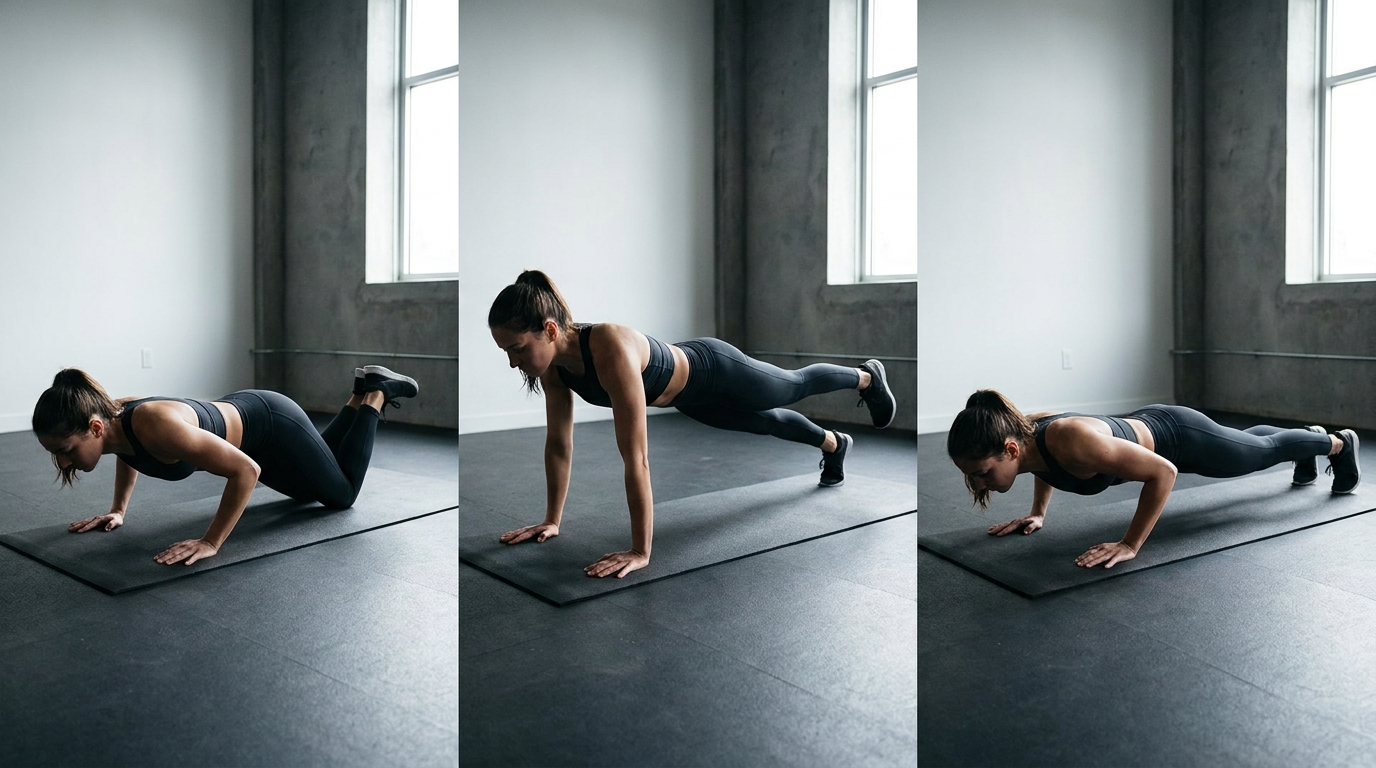
The short answer: Choose a push-up variation that lets you complete a small set with control and without pain. Start with two separated push-up-focused strength sessions each week, record what you actually do, and make one small change at a time. Wall push-ups count as a starting option; a floor repetition is not an entry requirement.
The NHS includes wall press-ups in its beginner strength guidance.[1] CDC guidance recommends strengthening at least twice weekly and covering all major muscle groups.[2] This article turns those general principles into a practical starting template. The exact sets, repetition ranges, and progression checks below are editorial suggestions, not a tested challenge or a promise of your first floor push-up by a deadline.
Stop if the exercise causes pain or you feel unwell. If you have an injury, persistent symptoms, or uncertainty about suitability, seek qualified advice rather than working through it. Mayo Clinic advises stopping painful exercise and allowing a full day between training the same muscle group.[3]
Choose a starting level without a maximum test
After a few minutes of easy movement, try three to five controlled wall push-ups. If those feel comfortable, you may try a stable high incline. There is no need to exhaust yourself to discover a level. Choose the version where you can stop the set before control deteriorates.
| Starting option | Setup and movement | Choose it when… | Easier adjustment |
|---|---|---|---|
| Wall push-up | Hands against a solid wall around chest height; bend the elbows to bring your body toward the wall, then press away. | Floor or incline repetitions are too demanding, or you want a gentle introduction. | Stand closer to the wall and use a smaller comfortable range. |
| High-incline push-up | Hands on a fixed, load-bearing surface that cannot slide or tip; maintain a straight body line as you lower and press. | Wall repetitions feel consistently manageable and the surface is secure. | Return to the wall or use a higher secure surface. |
| Lower-incline push-up | Use a lower secure surface with the same controlled movement. | You can manage a high incline without losing your body position. | Raise the hand position again. |
| Floor push-up | Hands on the floor; lower and press while keeping your trunk and hips moving together. | You can complete a few controlled repetitions without collapsing or straining. | Return to an incline rather than forcing incomplete repetitions. |
A household chair or loose table is not automatically suitable for incline work. Do not use glass, furniture on wheels, or a surface that shifts when pushed. If there is no secure incline available, keep using the wall; you do not need to buy equipment to start.
People already comfortable with floor repetitions can begin there with conservative volume. They do not have to repeat every earlier step. More difficult variations belong in a later decision, not in the first session by default.
Five form cues to use at every level
- Set your hands comfortably. On the wall, begin around chest height as in NHS guidance.[1] On an incline or floor, choose a comfortable position around shoulder width rather than forcing an extreme narrow or wide stance.
- Move as one unit. Keep your trunk and hips traveling together. If your hips sag or you have to arch to finish, end the set or use an easier level.
- Lower under control. Avoid dropping toward the support. Use the range you can reverse smoothly rather than forcing your chest to an arbitrary target.
- Keep your elbows comfortable. Let them bend in a controlled direction; do not force them straight sideways or tightly against your ribs.
- Breathe. Keep breathing through the movement instead of holding your breath to grind out the last repetition.
These cues are practical descriptions, not a remote form assessment. If you are unsure, a suitably qualified professional can help check your setup in person.
A two-day weekly template
Use Monday and Thursday as an example, or any two days with at least a full day between them. Account for other pressing work: hard dips, presses, or another push-up workout add to the same workload.
| Day | Plan |
|---|---|
| Monday — session A | Easy movement and a few easy practice repetitions; then 1–2 sets of 5–8 controlled repetitions at your chosen level. Rest until you can repeat with control. |
| Tuesday | No hard push-up-focused work in this template. Easy everyday movement is optional. |
| Wednesday | Other appropriate activity or rest; do not turn it into a test day to check progress. |
| Thursday — session B | Repeat the same level and range. Match Monday if it remains comfortable; reduce repetitions if control is worse. |
| Friday | No hard push-up-focused work in this template. |
| Saturday and Sunday | Rest or other suitable activity. Plan the next week's whole-body workload, not just more pushing. |
For a very gentle start, do one set of three to five wall repetitions instead of the table's larger range. The NHS wall-press-up example uses three sets of five to ten, but that is not a compulsory starting dose for everyone.[1] Begin below it if necessary.
Around one to two minutes between sets is a useful planning allowance, not a source-established requirement. Take longer when needed. If you still cannot repeat the movement with control, reduce the work rather than shortening the rest to make the session harder.
Push-ups do not cover all major muscle groups. Use the beginner calisthenics guide to place this work in a broader plan, and the bodyweight leg guide for the lower-body part of that discussion.
A progression rule you can track
Keep a short log: variation, support height if relevant, sets, repetitions, range, and how the final repetition looked. Compare the same movement under similar conditions rather than treating a lower incline as the same exercise as yesterday's higher one.
After two comfortable sessions at the same setting, consider adding one repetition per set. This is an editorial decision rule, not a research-proven threshold. Keep the same level longer if you prefer or if recovery is inconsistent.
Once two sets of eight feel repeatable, choose one next step:
- Keep the variation and practice cleaner, more consistent repetitions.
- Add a small amount of work if it fits your overall training.
- Use a slightly lower secure incline and reduce the repetition target again.
Do not lower the support, add sets, and add repetitions together. If moving to the floor leaves you unable to complete controlled repetitions, return to the incline. There is no failure in choosing a level that fits the session.
Regress the routine when needed
| What happens | Practical response |
|---|---|
| Your hips sag or your head reaches forward to finish | Stop the set; choose a higher incline or wall version next time. |
| Repetitions become rushed | Use fewer repetitions and allow more rest. |
| The support shifts | Stop immediately and change the setup; do not try to stabilize it mid-set. |
| You are unusually tired or still feel poorly recovered | Repeat a smaller session, use an easier level, or rest. Do not chase the logbook number. |
| Wrist, elbow, or shoulder pain occurs | Stop the provoking exercise. Do not assume a harder grip or deeper repetition will solve it; seek qualified advice for persistent or recurring symptoms. |
For later variety, see push-up variations. Treat those as options to evaluate, not a requirement to change every workout.
FAQ
Should I do push-ups every day?
Not as daily hard sessions in this starting plan. Leave a full day between training the same muscle group, as Mayo Clinic advises.[3] Rest days are part of the routine, not missed sessions.
How many repetitions should a beginner do?
Enough to practice control without reaching a point where technique breaks down. One set of three to five wall repetitions may be an appropriate starting experiment. Adjust the level and dose rather than trying to meet someone else's floor-push-up number.
Are wall push-ups too easy to matter?
They are included in NHS strength guidance.[1] Whether a version is demanding enough depends on the person and setup. Begin with a manageable option and judge it by control, comfort, and gradual progression rather than its appearance.
Can I combine this with dips?
Dips add more pressing work and may require equipment. Do not simply add them on top of the template without considering total workload and suitability. This article is a push-up routine, not a complete pressing-skill program.
What if I need an easier week?
Use fewer sets or repetitions, return to a higher support, or take more rest. The active recovery guide offers broader rest-day context. An easier week does not need to be followed by extra repetitions to make up a debt.
References
- NHS — Strength exercises. Wall press-up setup and gradual practice.
- CDC — What Counts as Physical Activity for Adults. Strengthening frequency, push-ups as an example, and major-muscle-group coverage.
- Mayo Clinic — Strength training: Get stronger, leaner, healthier. Recovery spacing and stopping painful exercise.