


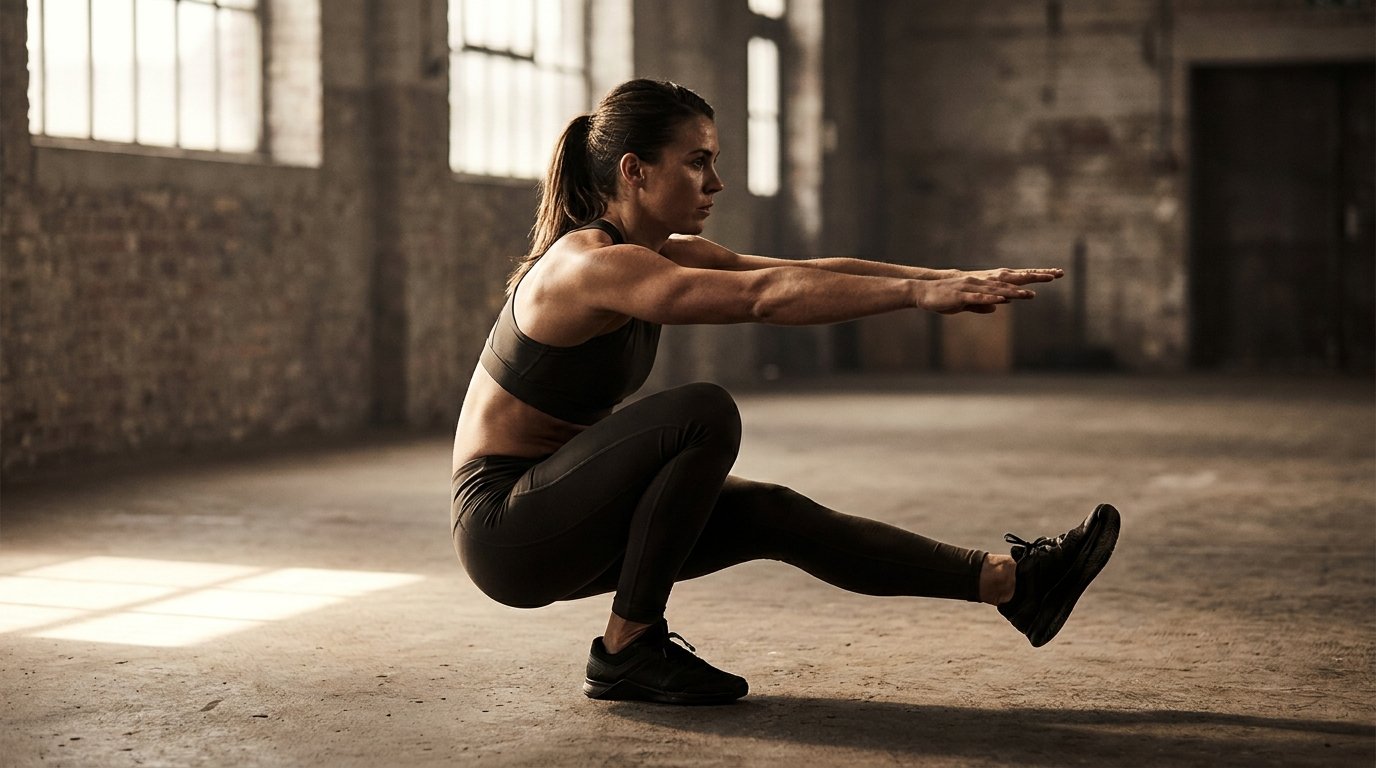
The short answer: A pistol squat is an optional single-leg skill, not a required measure of fitness. Start with ordinary supported leg work and consider small, assisted single-leg practice only when suitable. Progress by control and comfort, not a deadline or invented strength test. The milestones below are editorial options, not a proven mastery protocol.
| Milestone | Practice focus | Consider the next option only when… | Regression |
|---|---|---|---|
| 1. Comfortable basic squat | Controlled two-leg movement | Your chosen range is repeatable without rushing | Smaller supported mini-squat |
| 2. Assisted weight shift | Gradually more weight through one leg, other foot still assisting | Support and return remain controlled on both sides | Keep more weight through the assisting foot |
| 3. Small assisted single-leg lower | Very small range with secure support and a high target behind | You can stop and return without dropping or pulling hard | Touch the other foot down and shorten range |
| 4. Supported larger range | Modest range increase, keeping assistance | The same support and range stay manageable across sessions | Return to the previous high target/range |
| 5. Optional less-assisted practice | Reduce assistance without simultaneously deepening | You can reverse the chosen movement without a fall or forced effort | Restore assistance immediately |
Know what the skill asks of you
A full pistol squat involves lowering on one leg while the other is held forward, then returning to standing. It can demand considerable strength, range, coordination, and balance. Different people may find different parts limiting. This article cannot diagnose which factor applies to you.
The source package for this guide contains no verified pistol-specific progression study. NHS beginner guidance supports gentle mini-squats and gradual practice, not pistol prerequisites or a mastery ladder.[1] Mayo's rest and pain guidance is general strength guidance.[2] Do not read those citations as validation of a deep assisted pistol or a deadline.
You do not need twenty squats, an eyes-closed balance test, or a forced deep-squat hold to earn permission for ordinary exercise. None is presented here as a validated readiness test. The bodyweight leg guide covers a wider training goal; the pistol remains optional.
Make the environment forgiving
Use a clear, nonslip floor with room for the free leg. Choose only a fixed, load-bearing support you can rely on and a sturdy high chair or box that cannot slide or tip. A loose chair back, door handle, folding stool, or rolling furniture is not a suitable improvised anchor.
If you cannot verify the setup, do not attempt the assisted skill. Keep ordinary suitable leg work instead. A qualified coach can help assess the movement and equipment in person; this article cannot inspect either.
Stop with pain, dizziness, feeling unwell, or loss of control. Injury, symptoms, and uncertain suitability warrant appropriate advice.[3] Do not assume that adding assistance makes a demanding range safe for everyone.
How to use the milestones
Milestone 1: keep the ordinary squat useful
Begin with a familiar two-leg movement through a comfortable range. Use support if needed and do not force depth. The squat variations guide provides the detailed starting choices; this page does not replace that foundation.
You may remain with ordinary squats indefinitely. Reaching an advanced single-leg skill is not the only way to maintain a useful practice routine.
Milestone 2: shift weight while keeping assistance
With secure hand support, adopt a comfortable stance and put a little more weight through one leg while the other foot stays on the floor to help. Make a small bend and return, then reset before trying the other side.
Do not lift the assisting foot simply to make the exercise look like a pistol. Keep enough foot and hand assistance to stop or reverse easily. The purpose is a controlled transition, not discovering your maximum.
Milestone 3: a small assisted single-leg lower
Only if appropriate, use fixed support and a high stable target behind you. Put weight through the working leg; hold the other foot slightly forward and lift it only if you can maintain control. Bend the working leg a little toward the target, then return. You do not need to reach the seat.
If you lose control, restore the other foot to the floor and return to milestone 2. Do not drop onto a box or use it to catch a fall. If the motion feels too demanding even over a small range, stop the skill attempt.
Milestone 4: consider a little more supported range
Keep the same support. Explore only a modest increase in range that you can reverse smoothly. Do not lower the target, remove support, and add repetitions together. There is no requirement to reach a full deep pistol.
Avoid forcing the free leg straight if that compromises the whole position. A variation with a bent free leg is different from a full pistol, and should be labeled honestly rather than treated as a failed repetition.
Milestone 5: less assistance is optional
When the same small range is repeatedly manageable, you may consider slightly less assistance while keeping the range unchanged. Restore assistance if you wobble or need momentum. Unassisted practice is not compulsory and may be better assessed with a qualified coach.
A full-range unassisted pistol is beyond the beginner starting dose here. Do not chase it through forced depth, daily grinding, unstable supports, or an improvised heel lift.
A small practice structure
Prepare with gentle movement and familiar easy leg repetitions. Select one suitable milestone and try one to three controlled repetitions per side. Rest fully enough to repeat comfortably; one to two minutes is merely a starting planning allowance. If appropriate, repeat one small set, then stop skill practice for that session.
These counts are editorial limits for a conservative trial, not validated prerequisites or a clinically tested dose. Leave a full day between same-muscle strength sessions, consistent with Mayo guidance, and count other leg work too.[2]
Log assistance, target height if used, actual range, and control. Repeat a manageable stage before changing it. Regress by adding foot assistance, restoring hand support, shortening range, or returning to ordinary leg work. The lunge variations guide offers a different movement to evaluate, not an automatic remedy for a painful pistol.
FAQ
How long will mastery take?
No deadline is supported here. You may choose not to pursue the skill at all. A calendar cannot establish individual suitability or predict how quickly a complex movement becomes manageable.
Must my working heel stay down?
Do not force depth by shifting into an uncontrolled position or adding an improvised heel lift. Use a smaller supported range and get qualified feedback if the setup is unclear. This guide does not prescribe a universal technical fix.
Is a high box a safety guarantee?
No. It must be stable, and you must control the movement rather than fall onto it. If that is not possible, use an easier stage or stop.
Should I practice every day?
This starting structure is not daily hard single-leg work. Preserve recovery between same-muscle strengthening.[2] More attempts are not automatically better skill practice.
Can I build a beginner plan without pistols?
Yes. The beginner calisthenics guide uses simpler practice. A pistol is not its graduation test or proof of useful leg training.
References
- NHS — Strength exercises. General supported mini-squats, not pistol technique validation.
- Mayo Clinic — Strength training. General rest and pain guidance.
- NHS — Strength and Flex how-to videos. Suitability and stop rules.