


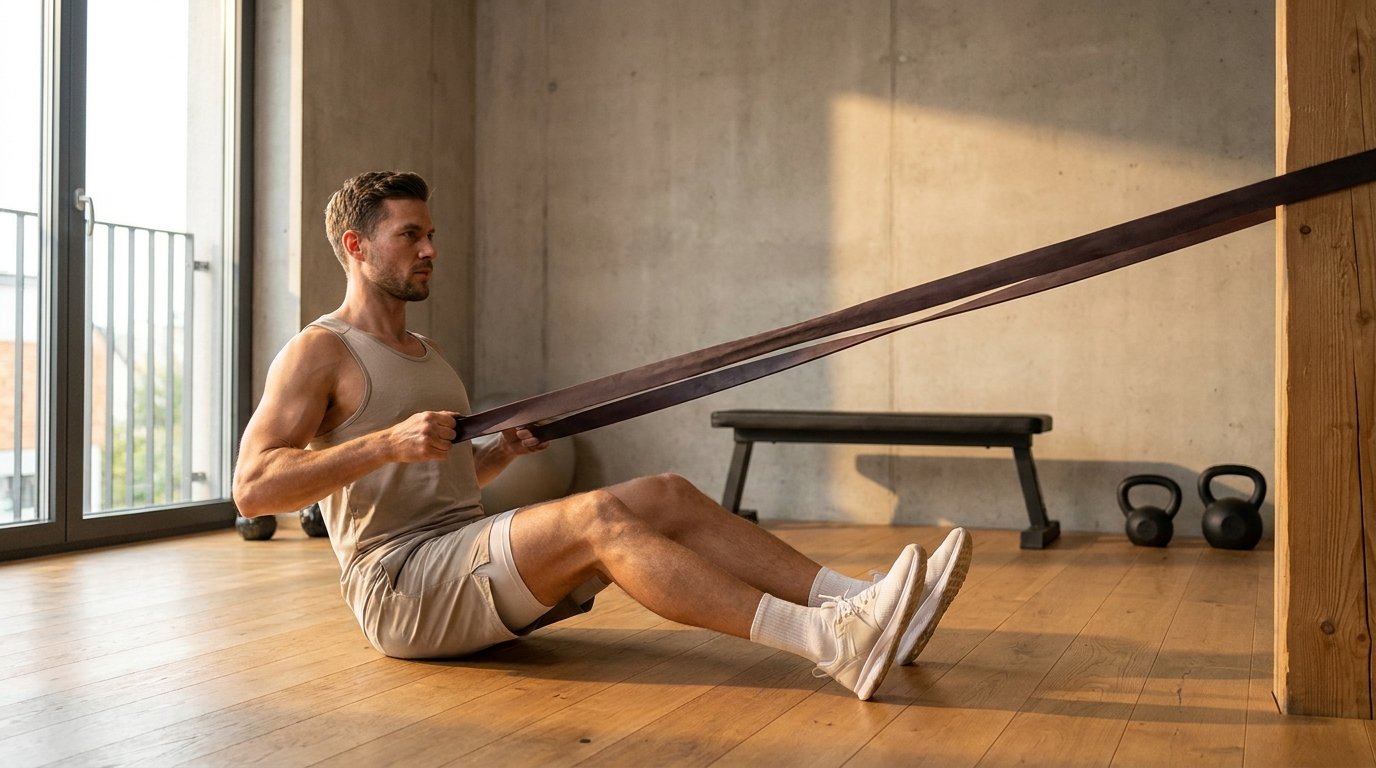
The short answer: Bands are equipment—an exception to this site's no-gear theme, not literally equipment-free training. Inspect them before each use, follow the specific product's setup and stretch limits, and choose manageable resistance. This routine uses self-anchored options only when approved for your band; never improvise a door or furniture anchor to complete it.
| Pattern | Starting option | Equipment-free alternative | Coverage limit |
|---|---|---|---|
| Legs | Band squat | Comfortable bodyweight squat | One movement is not every leg exercise |
| Hip movement | Band hip hinge | Small unweighted hinge or floor bridge | Choose a familiar comfortable range |
| Back/pulling | Underfoot band row | Light prone W practice if suitable | The alternative is not equivalent pulling resistance |
| Chest/pressing | Behind-back band press | Wall push-up | Setup and product compatibility matter |
| Shoulders | Light band side raise | Small unloaded arm raise | Unloaded movement is not equal resistance |
| Arms | Band curl | Gentle unweighted elbow movement | Alternative does not reproduce the load |
| Trunk | Unbanded heel slide | Same movement, or suitable seated alternative | The routine does not need a band on every exercise |
Understand your product before a workout
Mayo describes tubing as portable strengthening equipment that provides resistance when stretched.[1] Color is not a standardized load across brands. The same color or length does not establish equivalence to a particular dumbbell weight.
A long flat band, handled tube, and short loop are not interchangeable for every exercise. The examples below require a product whose instructions allow the stated setup. If yours does not, skip that option or use an alternative; do not tie knots, wrap extra layers around your hands, or stretch a short loop farther to imitate a long band.
Inspect the band and handles for cuts, tears, deterioration, or loose connections. Arkansas Extension advises checking tubing and securing it underfoot or at an anchor before exercise.[2] That is not universal permission to attach any product to a door. A user-owned band's condition, rated anchors, and stretch limit have not been verified here.
Anchor and recoil checks come first
Use clear, nonslip footing and suitable footwear where the manufacturer requires underfoot anchoring. Test a setup with very light tension before exercise. Keep the band securely positioned as instructed, away from sharp surfaces, and never stretch beyond its specified limit.
No external anchor is needed for the examples, but self-anchoring can still fail. Stop immediately if the band or grip slips, a connection moves, or damage appears. Keep your face out of a possible recoil path. Return under control rather than letting the band snap back.
If the only way to perform an exercise is an improvised door or furniture anchor, do not perform it. Obtain a manufacturer-approved setup and appropriate instruction separately. “Portable” does not mean every available object is a safe anchor.
The exercise instructions
These are editorial examples, not exercises validated as a package by the cited sources. Product instructions take priority for compatibility. Stop with pain or feeling unwell; injury, symptoms, and uncertainty about suitability warrant qualified advice.
Band squat
If approved for underfoot use, stand securely on the band and hold its ends or handles low beside your body. Start with light, manageable tension. Bend hips and knees through a comfortable range, then stand smoothly without pulling your hands toward your face.
Regress to an ordinary shallow squat if the band changes your balance or cannot stay secured. The squat guide provides the equipment-free setup.
Band hip hinge
With an approved underfoot setup and handles held low, soften your knees and move the hips back slightly. Return to standing under control. Keep the movement small and the band path away from your face; do not jerk upward.
Use an unweighted small hinge or a suitable floor bridge instead if the setup or movement is unfamiliar. More stretch is not automatically a better repetition.
Underfoot row
Using a compatible long band secured beneath both feet as directed, soften the knees and hinge a little at the hips. Draw your elbows back with hands moving toward your hips or lower ribs, then return slowly. Keep the band and hands below your face.
Reduce tension or omit the movement if the band slips or the position is uncomfortable. Light prone W practice is an alternative activity, not equal loaded pulling. Do not claim the no-band substitution fills the same strength-training role.
Behind-back press
Only if your manufacturer's instructions permit it, place a suitable long band across the upper back—not the neck—and hold the ends securely beside the chest. Press forward through a comfortable range, then return under control. Do not place a loose loop where it can ride toward your neck or face.
If compatibility or positioning is uncertain, use a wall push-up instead. Do not improvise an anchor to preserve a band-only workout.
Light side raise
With a compatible underfoot setup, raise the arms a small distance outward with soft elbows, stopping below shoulder height or earlier if appropriate. Lower smoothly. Use very light resistance; do not shrug, swing, or pull the band toward your face.
Reduce the range or practice unloaded arm movement if tension is not manageable. This option is not an instruction to work through shoulder symptoms.
Curl
With the band secured underfoot as instructed, keep upper arms near your sides and bend the elbows through a comfortable range. Lower slowly without snapping the band downward. Maintain stable footing throughout.
Use lighter resistance or an unloaded movement when needed. Unloaded elbow movement is not equivalent strengthening; label the change honestly.
Unbanded heel slide
Lie on your back with knees bent if floor access is comfortable. Slide one heel away a small distance and return, then switch. Keep breathing and avoid forcing a back position. Regress to a shorter slide or suitable seated alternating foot movement. No band is needed.
Put the routine into a week
After a few minutes of easy preparation, choose suitable movements from the table. Begin with one set of around five controlled repetitions each, or three per side for heel slides. Rest until you can reset safely; one to two minutes is an initial allowance, not a fixed requirement.
Repeat on a separated day, such as Monday and Thursday. Mayo advises a full day between same-muscle strengthening and stopping painful work.[3] CDC recognizes resistance bands as strengthening activity and emphasizes all major muscle groups.[4] This broad starting selection is not a claim that every possible substitution provides complete coverage; in particular, removing loaded rows leaves a pulling gap.
Repeat before progressing. Add a repetition, a set to one suitable movement, or a small manufacturer-permitted resistance change—not all together. No band's color supplies a universal next level. For broader planning, see the beginner calisthenics guide.
FAQ
Can I use a door handle as an anchor?
Not as an improvisation. Use only compatible, rated, manufacturer-approved equipment and instructions. This routine does not require an external anchor.
Is every color the same resistance?
No. Do not compare colors across products as standardized weights. Check the actual product information and how its resistance changes with stretch.[1]
Are bands literally no-equipment training?
No. They are a portable equipment option. The alternatives are clearly labeled, including where they do not reproduce the same resistance.
Can I keep using a small tear?
Do not continue with damaged tubing; inspect and replace it according to product guidance.[2] A successful previous repetition does not guarantee the next one.