


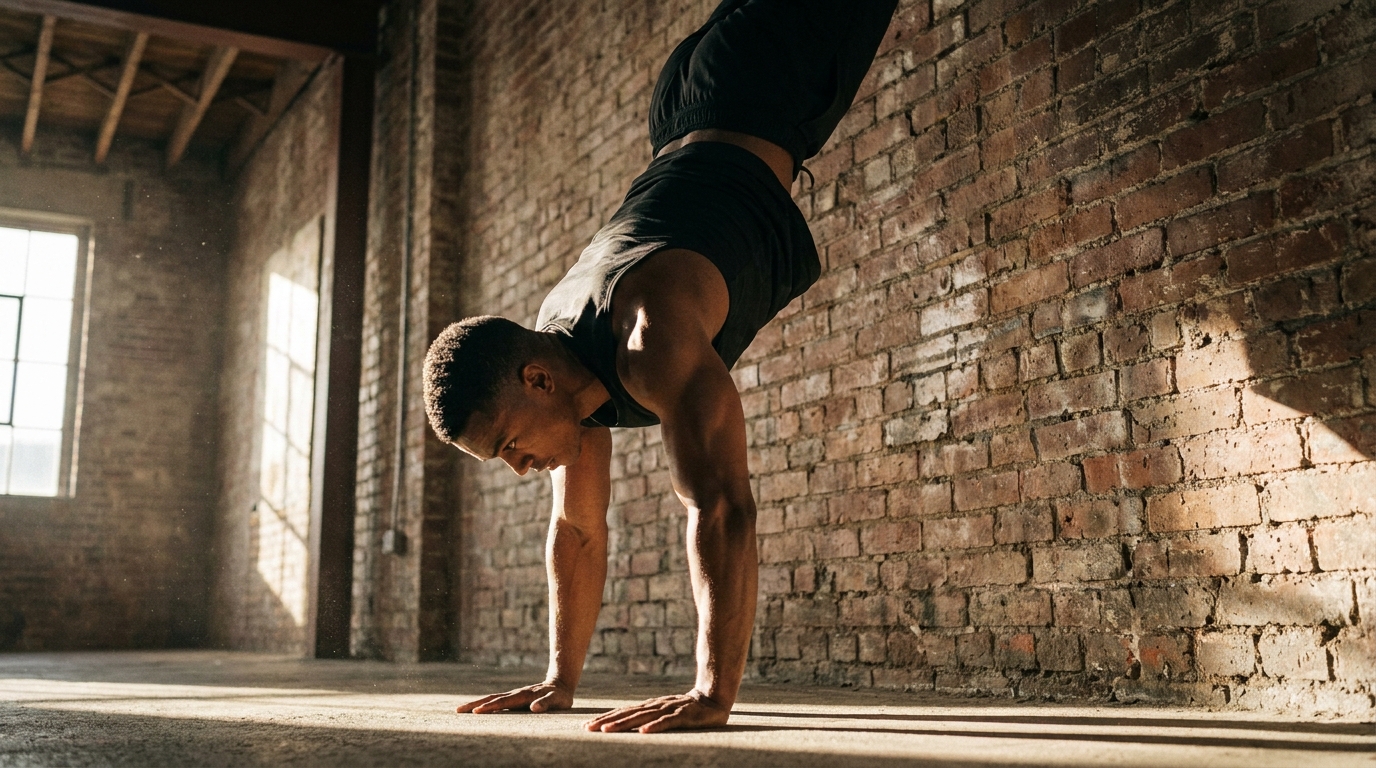
Most people assume you need a fully-loaded barbell rack to build serious strength. After a decade of coaching, I can tell you that’s the most expensive myth in fitness. The smartest athletes I work with train with bodyweight progressions and a handful of cheap tools — and they out-lift people twice their size.
That’s the whole idea behind Handstand Push-Up Progression: Wall to Freestanding: taking a movement you already know and engineering real overload into it without ever touching a plate.
Why bodyweight progression works
The principle is the same as adding plates to a bar — you have to give the body a reason to adapt. When you can’t make the load heavier, you change the leverage, the tempo, the stability, or the range of motion. The body has no choice but to get stronger.
Research on calisthenics athletes shows muscle thickness and strength gains comparable to traditional resistance training when progressions are properly programmed. The catch is most people stop at the beginner variation and never progress.
The progression framework
Here’s the ladder I use with every athlete. Each step is a real overload stimulus — moving to the next level should drop your rep count by 30–50%.
- Volume progression — drive reps from 3×5 up to 3×12 before moving on.
- Tempo progression — slow the eccentric to 3–5 seconds per rep.
- Leverage progression — shift the load (e.g., archer push-ups, shrimp squats).
- Stability progression — move to a less stable surface (rings, single leg, single arm).
- Range-of-motion progression — deepen the movement (deficit, full planche lean).
Programming it into your week
Pick 2–3 progressions and rotate them across the week. Treat each like a main lift — warm up thoroughly, work in the 4–8 rep range, and log your numbers. Add a rep or a level every 1–2 weeks when the current step feels easy.
Common mistakes
- Skipping levels — ego jumping straight to the hardest variation usually means bad form and zero overload.
- No deload week — high-skill bodyweight progressions beat up tendons more than muscles. Every 4–6 weeks, take a 50% volume week.
- Forgetting scapular strength — pulling progressions need pull-up bar rows and scapular pulls as accessories.
FAQ
How long until I see results? Strength gains in 4–6 weeks, visible muscle in 8–12. Skill progressions like handstands take 3–6 months.
Can I combine bodyweight and weights? Absolutely — many of my athletes use weights for accessories and bodyweight progressions for main lifts.
Save this progression, track your reps, and stop letting the absence of a gym be the reason you didn’t train. Handstand Push-Up Progression: Wall to Freestanding is your blueprint.