

You don’t need a gym to build real muscle. You need a pull-up bar (optional), a floor, and a plan that respects how the body actually grows: progressive tension, full range of motion, and consistency over months — not intensity over a single week.
This is the complete guide to bodyweight training: how it builds muscle, the five movement patterns that cover your entire body, a sensible progression ladder for each one, and a weekly template you can start using today. No equipment. No supplements. No nonsense.
Why bodyweight training works for muscle growth
Muscle growth — hypertrophy — happens when you place a tissue under more mechanical tension than it’s adapted to, then recover. Where that tension comes from is irrelevant: a barbell, a dumbbell, a band, or your own bodyweight will all work, provided the stimulus is high enough and progressive over time.
Two things make bodyweight training especially effective for naturals training at home:
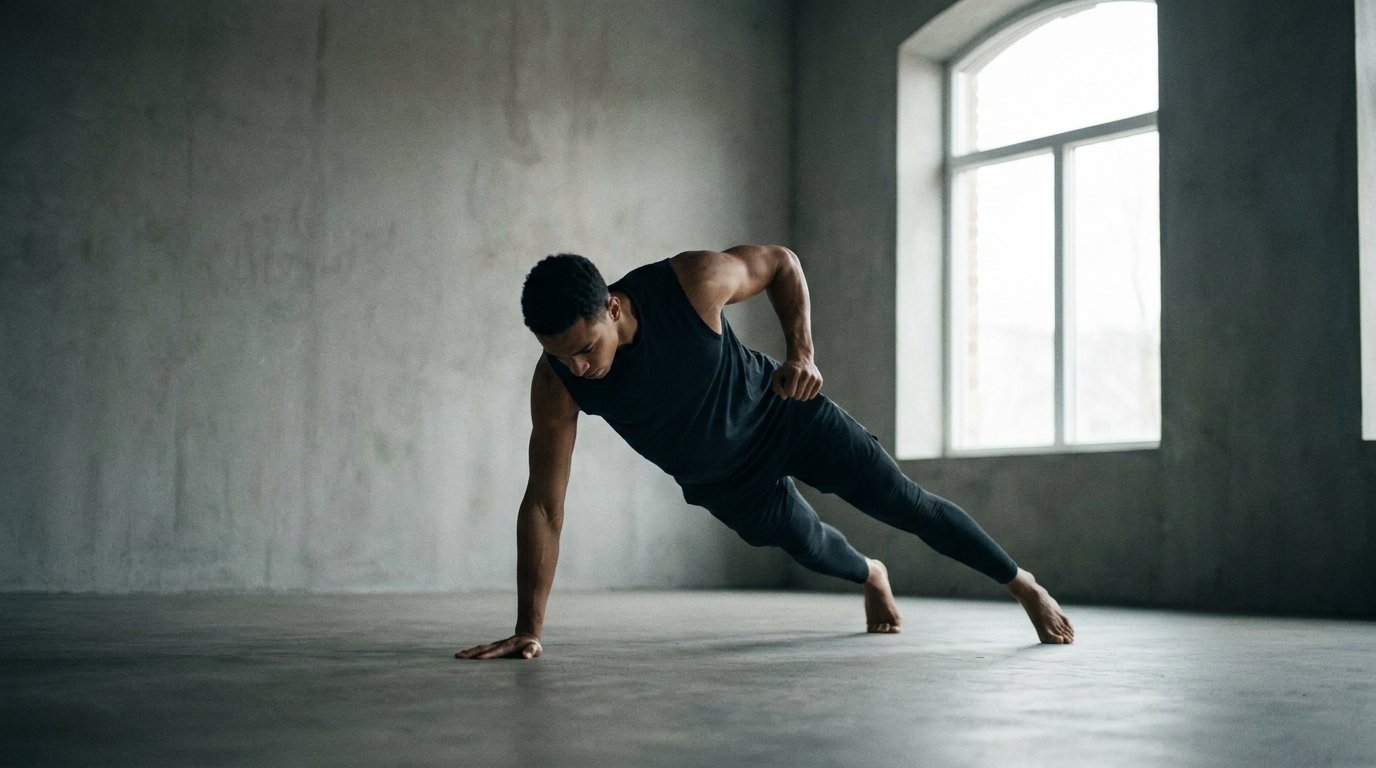
- Range of motion scales with you. A beginner push-up uses a small range; a deep pseudo-planche push-up uses almost the entire pec, anterior delt, and triceps range. You control the difficulty by changing angles, leverage, and tempo — not by adding plates.
- Stabilizer demand is high. Free-weight bench presses are stabilized by a bench. Handstand push-ups are stabilized by your entire shoulder girdle and core. The result is more muscle recruited per rep, especially in the midsection and upper back.
The mistake most beginners make is treating bodyweight training as “easy” because there are no plates to load. In reality, an advanced calisthenics athlete doing one-arm pull-ups and weighted dips is producing more force than most casual lifters ever will. The ceiling is just harder to see until you start chasing it.
The five movement patterns you need to master
Forget “chest day” and “leg day.” Your body speaks five languages. Train all five, two to three times a week, and you’ll build a balanced, capable physique that looks and performs like an athlete’s.
- Push (horizontal and vertical) — push-ups, dips, pseudo-planche push-ups, handstand push-ups, pike push-ups.
- Pull (horizontal and vertical) — inverted rows, pull-ups, chin-ups, archer pull-ups, front lever work.
- Squat — bodyweight squats, Bulgarian split squats, shrimp squats, pistol squats, jump squats.
- Hinge — glute bridges, single-leg glute bridges, Nordic curls, reverse hypers (using a table edge).
- Core / anti-movement — planks, hollow holds, ab wheels, dragon flags, L-sits, hanging leg raises.
That’s the whole menu. Every bodyweight program ever written is some combination of these five, with progressions applied to make each harder as you adapt.
The progression ladder: how to keep getting stronger
Progressive overload doesn’t require a weight rack. There are at least seven ways to make a bodyweight exercise harder, and you’ll cycle through all of them over a year or two:
- Range of motion — partial push-ups → full push-ups → deep deficit push-ups.
- Leverage — regular push-ups → pseudo-planche push-ups → planche push-ups.
- Stability — squat on two feet → Bulgarian split squat → pistol squat.
- Slow eccentrics — 1-second descent → 5-second descent → 10-second descent. Brutal and effective.
- Density — 3 sets of 8 → 5 sets of 12 → 10 sets of 5 (cluster sets).
- Unilateral work — two-leg squat → Bulgarian → pistol. Half the weight, double the demand on the stabilizers.
- Mechanical advantage shifts — pull-ups → archer pull-ups → typewriter pull-ups → one-arm pull-ups.
The key is: don’t add sets, add difficulty. If you can do 3 sets of 15 push-ups with clean form, you don’t need more push-ups — you need a harder push-up variation. Bumping sets past ~15 per exercise is where bodyweight training starts wasting your time.
A weekly template (3 days, full-body)
Three full-body sessions a week is enough to build muscle for almost everyone outside of advanced competitors. Here’s a simple, scalable template. Pick the variation that gives you 3 sets of 6–12 with clean form and 1–2 reps in reserve.
- Day A — Push + Pull + Legs: Push-ups (or pike/HSPU progression), inverted rows (or pull-ups), Bulgarian split squats, Nordic curls, plank.
- Day B — Push + Pull + Legs (different angles): Dips, pull-ups (or chin-ups), shrimp squats, single-leg glute bridges, hanging knee raises.
- Day C — Push + Pull + Legs (harder again): Pseudo-planche push-ups or archer push-ups, archer pull-ups, pistols, dragon flags or L-sits, jump squats for power.
Rest 60–90 seconds between sets. Each session should take 45–60 minutes including warm-up. Cycle the exercises every 4–6 weeks so you don’t grind through the same adaptations indefinitely.
Common mistakes (and how to fix them)
- Doing endless push-ups instead of progressing. Fix: stop adding reps past 12–15. Pick a harder variation instead.
- Skipping pulling work. Fix: pair every push session with a pull of equal volume — horizontal pulls if you don’t have a bar yet.
- Neglecting legs. Pistol squats, Bulgarian split squats, and Nordic curls build serious lower-body and posterior chain strength. Don’t treat legs as an afterthought just because you’re at home.
- No warm-up. Five minutes of dynamic mobility (shoulder circles, hip openers, scapular pulls) dramatically reduces injury risk and improves movement quality on the first sets.
- Training through junk volume. Three hard sets beat six sloppy sets every time. Form first, reps second.
The bottom line
Bodyweight training isn’t a compromise. For most people training at home, it’s the most efficient, joint-friendly, and sustainable way to build a strong, muscular body. Master the five movement patterns, progress through leverage and range instead of just adding reps, hit three full-body sessions a week, and eat enough protein to recover.
Do that for six months and you won’t recognize the person in the mirror.
No Gear Fit — bodyweight training, no equipment required. Browse the full library of workouts, nutrition, and recovery guides to keep the momentum going.